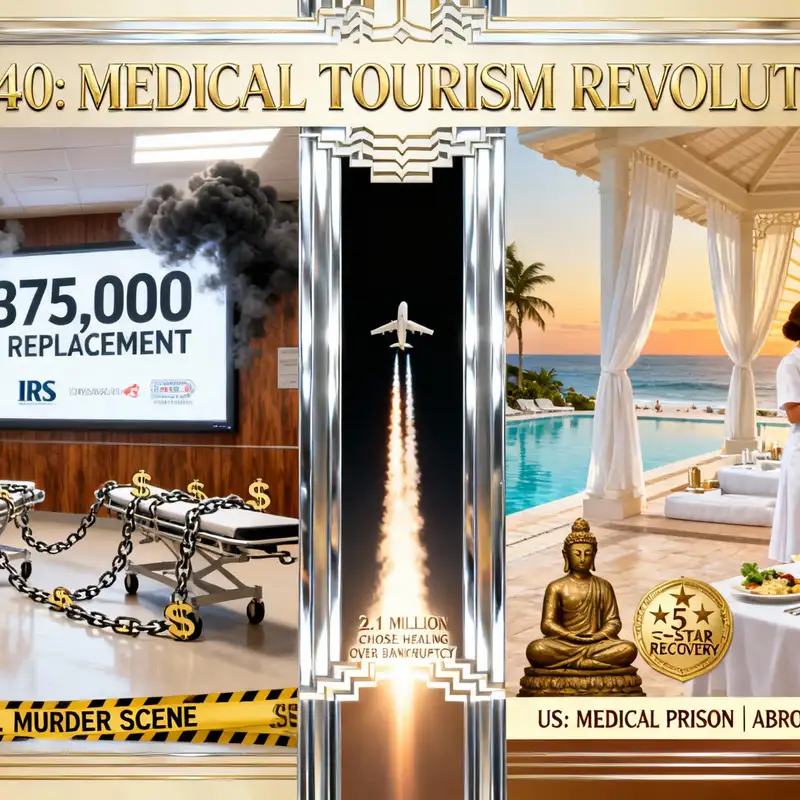
S2E40 Medical Tourism Revolution - Escape the Medical Cartel LIVE AMA
Welcome back to The Aaron Day Show. This is season two, episode forty. Let me fix the screen here real quick. There we go. Season two, episode forty. And tonight we're going to be talking about medical tourism. This is a topic that we've touched on a little bit in the past, but I wanted to walk through what's going on already today in the world with medical tourism. As I've mentioned, we're working on a medical tourism marketplace for Zeno built on the Zeno platform that allows for privacy and at the same time for the creation of a reputation management system. I'm not gonna go into details on that tonight. I mean, I'm gonna touch on conceptually what we're doing, but what I wanted to do is give an overview of the current state of the market with medical tourism, because it's already a robust market that you can access today. This isn't something that's waiting for us to create a privacy based marketplace, certainly that will help moving forward, but it isn't necessary. You can start to learn about and engage in medical tourism today. So I wanted to walk through kind of the market and give some examples of things that are already going on around the world that can help you lower your health care costs and improve outcomes today. So that's what we'll be talking about The last couple episodes have been really interesting. Last week, we were supposed to have Mike Adams. Mike's going to be on on November the sixth. But what we did do was talk about the state of AI and the fact that you can now have AI on your local computer, including Mike's Brighteon AI, which is uncensored. So this is something that you can have on your own computer that isn't connected to the internet and it's free. And so, so often we talk about the downside of AI and we don't spend any time talking about how this technology can be used to improve our lives and to improve our free will and give us more available choices and more available information. to make decisions about our lives. And so we talked about that. And then I also introduced this concept of video and audio avatars, which I'm gonna bring back again today, just so that you can see the incremental improvement. It's very much still a work in progress, but you'll even see from this week, well, Monday, from Thursday, there's been already a pretty big improvement in terms of the quality of audio. and video and moving forward, this I believe will end up being real time. So the ability to interact, all of this is essentially it's a front end. So you can ask any question you want and I can pull the information from Enoch and then present it to you in a voice. or with a voice and a body and an avatar, which I think the usefulness of that is it helps people that are intimidated by computers. It provides a user-friendly front end. But the real important part is that it's actually censorship. It's uncensored information. More importantly, what I can show you, because I've made a lot of progress in this regard as well, is you can start to build your own databases of information. So maybe we'll test this out tonight. I've taken hijacking Bitcoin and I've put it into a database that can be accessed by the AI. So the AI can call and reference the entire hijacking Bitcoin book. i've taken the entire brownstone institute catalog every article written by brownstone institute i have available to me on my database which can be accessed through this avatar system the technocracy i have eight thousand articles on technocracy right now i'm in the process of building a database if you followed mark passio and his work he has something called the arc which is a couple of terabytes worth of information, like eight thousand books and a whole bunch of audio and video. I'm indexing the entire ARC library of information about a whole variety of concepts, the occult and a whole natural law variety of different areas. The books are already done. It's going to take, you know, a couple of weeks, probably. It depends on how I set up the system. But the point is that The problem that people have with the internet is they're like, well, I typed this in and of course, you know, chat GPT or GROK is giving me censored information or it's giving me all these other sources. We have the ability to decide what sources go into the AI and then we can pick which AI we use to present the information. So we can control these things at all of these different levels. And I think being able to make those tools available is a game changer and it's something I'm spending, frankly, about twenty hours a day working on these days. So please check out that episode, and there's going to be more to come. I think I'll probably be talking about AI on every episode now, and not just talking about it, showing something every episode. Because rather than being fearful of AI, I want to help people understand how to use AI, kind of like crypto, right? CBDCs are bad. Government regulated stable coins are bad. Privacy coins like Zeno or privacy stable coins like Freedom Dollar are great. They're actually a vast improvement over fiat currency. And the same is true in the AI realm. And so I'm going to continue to show people this. The podcast prior to that was on the healthcare prison, which kind of leads into our talk tonight, but it was basically a discussion of, it was a broader discussion going over twenty-five hundred years on how we've essentially had this, you know, this fight between two sides. One side that says, you know, humans, there's something innately valuable and unique about humans that we have the ability to self-heal. and should pursue modalities that that actually assist our body in its natural healing capabilities. And then the other approach that says, we're machines, and one size fits all solutions should be applied to us as a machine as if we were, you know, an interchangeable set of auto parts or something like that. And There's a long history of this going back twenty five hundred years, but this is now playing out in the A.I. realm as well. And so in this episode we talked about I went through the whole history of that and what it means right now for for A.I. in health care, which, again, A.I. in health care could be a phenomenal thing. It should be a phenomenal thing. Unfortunately, we have things like Operation Stargate. with Larry Ellison and Sam Altman and others, where they want to centrally control and house all of our health information. And this also includes Palantir, which is now building a national database of healthcare information, which they're already doing, by the way, in the UK with the NHS. We need to be aware of what the technocrats are doing with AI, but equally as important as being aware of what they're doing, we need to figure out what we can do to use this great technology to help empower us in a way that's individual and private. So as always, I encourage you to go to the aarondayshow.com website and use that as the primary place. And you can watch this wherever you want, but you know, if you have an account, free account there, you can comment, you can view all of the other content on the site, including the music, memes, the first principles project, And there's going to be a lot more here as well moving forward. I'll continue to do things like giveaways like we did the the two hundred twenty dollar freedom dollar giveaway, which I think we've given almost all of that out. And we're going to continue to do more. I think I'm going to do something with BTCX, which is private Bitcoin and something with ETHX, which is private Ethereum. I'll do a giveaway using that as well. But I think it's important given the nature of this content to understand, I fully expect to be more shadow banned moving forward. So also the more people are going to these individual sites that we're creating, the less likely we are to experience censorship. I did want to talk about also, you can go to technocracyatlas.com. As I mentioned, there are five things that we're rolling out, five websites, five projects, and the last of them is Technocracy Atlas. You can go to technocracyatlas.com right now. You can sign up for the wait list. As I mentioned, I've already, over the weekend, built out kind of a chatbot AI. where you're going to be able to search and query information about technocracy that has all of the best information out there and the kind of information you will not get through the other AIs. But then I'm going to build a graph database in the future where you're going to be able to map relationships, map funding and map concepts as a way to stay on top of this, because technocracy versus freedom really is what everything what the big battle is right now that we're what we're facing are we going to lose free will and give it up to agi and technocrats or excuse me ai and technocrats or are we going to reclaim our free will and continue to expand as individuals and the technocrats are using all of these centralized systems against us they're surveilling us they're tracking us Well, what are we doing to fight back, to even identify who they are and what they're doing? And so the idea behind Technocracy Atlas is this is an open source, I call it an open source version of Palantir, where we can crowdsource information and expose what they're doing. So often, well, most people don't know what technocracy is, but so often people get into this, well, it's this group or that group. And the truth is that when it comes down to technocracy, it's an evolving network of of people that are interacting with one another to push a common agenda. It isn't one specific group. There are common players and organizations that have been involved in this almost one hundred year movement, but there are new players being introduced all the time. Well, the best way to understand what's going on is to document it, to put it out there in the public, to make it transparent. so that it's not speculation, so that you're not in the realm of conspiracy theories. You're actually tracking sourced information, and you're putting together, you may even put together a theory and map out relationships, which you can then later prove or disprove. But in the process, you're gaining understanding. So this is what Technocracy Atlas is all about. I will be going through the avatars again tonight. Again, not huge upgrades, but I will be able to show a couple of things. I'm going to make this a bigger part of this and some other things going on moving forward. Again, you can go to brightu.com and let me make sure I've got that URL right. Yeah, brightu.ai. My apologies, brightu.ai. That is, I'll put that link actually in the comments, brightu.ai. This is where you can go to download Mike Adams' free uncensored AI that's been trained, that he spent two million dollars of his own money building and training on data sets that you're not going to get anywhere. And if you followed his work at Health Ranger, he's been aggregating and putting together this information for decades. And then he's augmented that even further. Interestingly, I was supposed to have him on last week. And the reason he couldn't make it is there was a data center outage, which, you know, how convenient, you know, I wouldn't be surprised. This is the kind of thing people do not want to see out there. And once these data sets get out there, and once these databases you know index this information and these ais get trained then they can't take that back and so what he's done by releasing this ai is a huge service for humanity and the fight for free will so i encourage you to check that out if you don't want to download it you can you can still go to brighteon.ai and use the web version of it so so don't feel like you have to download it in order to use it but um i remember when he first told me he was doing this i'm like hey are you going to make a self-custody version of this that people can download he said yeah and so he he did he actually pulled that off and the fact that he got that out before anyone could stop him is great and so i encourage you to download it even if you're not going to do anything about it because in the future even if they shut off you know your internet connection you can still operate and use this ai on your computer without being connected to the internet As far as more housekeeping, we have the big Brownstone annual event coming up. Probably aren't any tickets left for that, but I hope to see many of you there. This is gonna be a terrific event, great speakers. This is one of my favorite events to go to. In fact, all the Brownstone events. are phenomenal. And so we're sponsoring this. My wife and I at Daylight Freedom Foundation are sponsoring this. So we're going to have a table there as well. And I'll be showing people the five different initiatives that we're working on and everything. So this is kind of our leveling up of the work that we've been doing for a couple of years, but now we're kind of pushing it to that next stage. Also, please check out the technocracy roundtables, all of them that we've been doing, but then last week's was very important because it was on this topic of healthcare AI, which I think is one of the most important areas and one of the areas where the technocrats have the most leverage because if they can control our health data and control our access to healthcare services, then that's going to be something that's pretty hard to resist. And so we had a very robust conversation about that. So before we get into this, for those that are new, and I touched on it earlier, the whole thrust of what we're doing here on this podcast and Daylight Freedom and so forth is in service of fighting for freedom against technocracy. And again, free will truly is at stake. If the technocrats have their way, You will have AI surveillance systems and social credit systems that are tied to a single global digital currency, which will be a carbon credit based system. And if that's the kind of world you live in, if the algorithms or scientists and engineers are deciding what you can and cannot do, then that basically is eliminating your ability to choose, which is an assault on free will itself. So this is why this is such an important And I think tokenization is one, or excuse me, war. This is why I think tokenization is the big battleground, because the way that they're looking to assert control is by creating digital programmable tokens that represent all of our assets, not just money though, which is what CBDCs and regulated stable coins are, which is tokenized fiat. But they're now moving to tokenize our stocks, our bonds, commodities. They're even looking to tokenize the national assets of the United States itself and sell those off. And so what this means is that in the future, if you say something the technocrats don't like, if you do something they don't like, if it looks like your genetics suggest you may have a health outcome that doesn't fit into their model, not only could they shut off your money, all of the assets that you own maybe even turn off your car and your ability to buy and sell everything not just use cash or fiat so this is why this is important and this is why xeno is an important solution because this is a way to tokenize things which tokenization is not inherently a bad thing this is a way to be able to tokenize things that's private where third parties can't see what you're doing or stop what you're doing And so what we're doing is three areas. One, technocracy takeover, which is exposing technocracy, making people aware that this technocracy ideology exists and that it is an ideology. It's not technology. It's an ideology about scientists and engineers making decisions for people. I certainly fully embrace technology. and want to make sure that that difference is clear, we promote the importance of rebooting and taking control of your autonomy and taking control of your own free will, taking back our free will, which has been hijacked by governments, by educational institutions, and increasingly by the media and big tech through algorithms, either through social media or AI. So once you're aware of that, you can take that back and start making your own decisions. And then the third area is building parallel solutions, building private solutions outside of this technocratic system. So those are the three big areas. So with that out of the way, so tonight, this is a very important topic because it could actually help save your life and could help save your life savings. So right now, as you're watching this, two point one million Americans are fleeing the country for medical care, not because they're poor, not because they're uninsured, but because they've discovered the biggest price fixing scam in human history. A hip replacement at Cleveland Clinic cost three hundred and seventy five thousand dollars. That exact same surgery performed by a U.S. trained surgeon in Bangkok cost twenty five thousand dollars. And here's the kicker. this it's called bum rung grad international hospital has a ninety eight point five percent success rate compared to the mayo clinic's ninety seven point nine percent success rate their infection rate is only point five percent versus the u.s average of one point nine percent so you're literally paying more in the united states to get worse care This isn't some underground black market operation. This is a one hundred billion dollar industry growing twenty five percent every year. Thailand alone receives two and a half million medical tourists annually. Mexico sees one point four million Americans cross the border every single year. There's a town called Los Algodones with five thousand four hundred residents and three hundred and fifty dentists offices. They call it Molar City. Americans drive there, get dental work at eighty percent discount, and then drive home the same day. But here's what should make your blood boil. The same Medtronic hip implant that costs thirteen thousand dollars in a U.S. hospital costs three hundred and fifty dollars in Belgium. The exact same device made in the same factory with the same serial numbers. Tylenol, the pill that costs ten cents at Walgreens, is billed at thirty seven dollars per pill in U.S. hospitals. Not necessarily that you should even take Tylenol, but nevertheless. Surgical gloves are fifty three dollars per pair. An MRI that costs three hundred dollars cash in Japan, or excuse me, that costs three hundred dollars cash in Japan costs thirty five hundred dollars if you have insurance in America. They literally charge you more for having insurance. Every hospital has a secret document called the charge master until it was illegal illegal for them to tell you prices before treatment. Now they're required to post them but refuse and pay the pathetic daily fine rather than reveal the markups. Five hundred and thirty thousand American families declare bankruptcy every year for medical bills. That's a that's sixty six point five percent of all bankruptcies in this country. And here's the gut punch. Seventy five percent of them had health insurance when they got sick. The average medical bankruptcy is forty two thousand dollars. That same amount covers five heart surgeries in India. Dr. Devi Shetty in Bangalore performs heart surgery for two thousand dollars complex cardiac bypass. His hospital does thirty heart surgeries per day with a ninety eight point five percent success rate. His doctors trained at Harvard are trained at Harvard and Johns Hopkins. The difference he runs health care like a business instead of a cartel. Meanwhile, the FDA is actively blocking treatments that work. German hyperthermia for cancer, a seventy-six percent response rate for certain cancers, is banned in America. Japan's immunotherapy reversed cancer in twenty-five percent of terminal patients. The FDA raided the US clinics offering it. Mexico's Gerson therapy has a fifty-year track record. It's illegal to even mention it works in the United States. IVF in America, thirty thousand dollars per cycle, thirty five percent success rate. Czech Republic, three thousand dollars per cycle, forty five percent success rate. They have better technology, better outcomes at ninety percent less cost. American fertility clinics are running a monopoly on human reproduction. Major employers have figured this out. Walmart, Lowe's, Pepsi, they're sending employees abroad for surgery. Blue Cross Blue Shield just launched their global care program covering procedures in Mexico. The insurance companies that created this mess are now admitting defeat. Let me paint you a picture of what thirty thousand dollars actually buys you in Thailand. business class round-trip flights for you and a companion, five-star beachfront recovery suite for fourteen days, surgery at a JCI-accredited hospital that's the same accreditation as Johns Hopkins, US-trained orthopedic surgeons, all medications, all follow-ups, private nurse twenty-four-seven, physical therapy twice a day, spa treatments, organic meal plan, and tourist excursions for your companion. At the Cleveland Clinic, thirty thousand dollars doesn't even cover the surgery room fee. This isn't about being anti-American, this is about being pro-survival. The US healthcare system is designed to extract your entire net worth when you're the most vulnerable. It's not broken, it's working exactly as intended. Forty-five thousand Americans die every year from a lack of insurance, while hospital executives make eight-figure salaries. Medical tourism isn't new. Greeks traveled to Epidaria, twenty-five hundred years ago. Romans went to hot springs. The European aristocracy toured spa towns. The difference is that today we're not seeking medical care, we're fleeing medical predators. The revolution isn't coming, it's here. Every person who gets on a plane for a surgery is a vote against the system. Every medical tourist is a declaration of independence from the medical cartel. And tonight we're going deep, which countries for which procedures, how to verify hospital accreditation, how to check surgeon credentials, medical visa requirements, insurance that covers international treatment, recovery timelines, tax implications, and we're building something bigger. A Zeno-powered medical tourism marketplace with escrow-protected payments and reputation tracking. Because here's the truth that they don't want you to know. You don't have to die in debt. You don't have to choose between your health and your home. You don't have to accept their monopoly. Fourteen to twenty million people worldwide have already figured this out. They're not medical refugees, they're medical revolutionaries, and tonight you can join them. Your three hundred thousand dollar surgery costs thirty thousand dollars abroad. Better care, better outcomes, better life. How much longer are you going to let them rob you? So before I go into the detail on this, I want to go through I want to show you some a clip, a collage of clips that I put together of people talking about their own experiences using medical tourism and and so see these are interesting videos in part because you can see the kinds of technology and equipment and facilities that are out there we have this complete myth that we have we have like Frederick Flintstone level technology our hospitals are an absolute joke this whole idea that the technology is better than everything else is a complete fiction so uh let me show you Hospital prices in Turkey that would send Americans into a coma. I visited a luxury hospital in Turkey and the prices compared to the US are shocking. Last year I came here for their VIP checkup and met with an internal medicine doctor, cardiologist, ophthalmologist, gynecologist, had a chest x-ray, DEXA scan, abdominal ultrasound, mammogram, echocardiogram, stress test, blood test, and test for cancer markers all for eleven hundred dollars. That went so well that we came back and my boyfriend did their three-day comprehensive checkup package that included meetings with a gastroenterologist, internal medicine doctor, cardiologist, neurologist, urologist, cranial MRI, thoracic CT scan, abdominal ultrasound, echocardiogram, stress test, colonoscopy, upper endoscopy, colon and stomach biopsy, and had blood tests that checked for forty-two biomarkers and six cancer markers, all for three thousand seven hundred and fifty dollars. doing that in the u.s would have cost us like thirty grand why are people flying all the way to places like thailand just to visit the dentist well today i'm here for a checkup in bangkok and i'm gonna show you exactly why So I'm at the BDMS Wellness Clinic here in Bangkok. I was actually pretty surprised at how extravagant this place was. They even had a dinosaur from Isan, the Siamosaurus. So it's actually been a while since I visited the dentist, so I made an appointment for a service called the Full Mouth Rehabilitation. For whoever have to restore all of their teeth, they have the crowns, they have a decay, or they have like a worn dentition. I've had some tooth pain recently, so we started off by doing a high-tech scan to search for any problems. And this scan is not just about fixing teeth, but it's also to restore your bite and overall tooth health. And it turned out I just needed braces. But it's pretty crazy what they do here. I think it's the only dentist in Asia that can make a crown in one day. You can even see it happening in this little room in one of the hallways. But as a regular coffee drinker, I was referred for a tooth cleaning session, which, by the way, was also state-of-the-art. Probably the most comfortable cleaning I've had. There's no horrible injections, and you get to watch the Zen TV. and just look at those pearly whites absolutely world-class service at this clinic and if you do need to fix your smile whether it's veneers crowns or implants check out the full mouth rehab follow for more thailand content baby i've been on dialysis for about a year my daughter said i'm your kidney nobody would do it not a states won't do this and they were free just because past cancer i felt like This is a last chance. I researched and found medical tourism. Best place to come with India. If you research it online, it's like, say it's dangerous. I never once felt that here. Felt secure here. Everybody's so kind. The doctors and the team were right on top of everything. By the time I got to surgery, I felt like I was at home. They gave me my daughter's kit and I started walking yesterday. Ever wondered how Mexico's healthcare system compares to other countries? Let's break it down! Here are the key differences you need to know. Medical treatments in Mexico can be up to eighty percent cheaper than in the U.S., making it a top destination for medical tourism. Public and private blend Mexico offers both public and private healthcare, but only about half of the population has full coverage. Quality of care Some hospitals in Mexico are JCI accredited, matching international standards, but public hospitals can face resource shortages. Access. Unlike Canada or Europe, Mexico doesn't have universal healthcare, but it's working on expanding coverage. Medical tourism. Mexico is a global leader in medical tourism, offering affordable and high-quality care for international patients. Interested in learning more about global healthcare differences? Please like, follow, and subscribe for more insights. So there you have it. It's actually fascinating when you go and start digging into these clips. And I encourage you to go to YouTube or social media and just Google this and watch what people have to say about their experiences. Now, of course, not all experiences are great. There are certainly also stories about people getting abducted by the cartel and everything else in Mexico. So when I do talk about medical tourism, understand that what this is about is about Using your choice using your using the free markets, but you still have to do your homework. So you can find incredibly bad options, as well as options that are much better than what we currently have. But understand that there are options that are significantly better than what we currently have, if you know how to look for them. And as I mentioned, this is a hundred billion dollar industry now. So the average hip replacement in America is three hundred and seventy five thousand dollars. That same surgery performed by a U.S. trained surgeon in Thailand is twenty five thousand dollars. And as I mentioned earlier, including the flights, the private recovery suite overlooking the ocean and a full time nurse for two weeks and the success rate, if you're going to this one particular hospital, Bumrunggrad in Thailand has a higher success rate than the best facility in the United States. And it has an even lower infection rate by a significant margin than what you're about to get here. The Cleveland Clinic charges four hundred and twenty three thousand dollars for a cardiac bypass. Fortis Hospital in India charges seven thousand nine hundred dollars with better outcomes. And I can't stress this enough. This isn't about, you know, this perception is, oh, you're getting doctors that don't know what they're doing. This is like, you know, you're getting the B team, you're getting people that are cutting corners or whatever that happens to be. But when you do your homework on this, you'll find that a lot of these are US-trained doctors, or these are doctors that are trained in some of the best medical schools around. And they got fed up with the way that the system works and wanted to be able to operate in a way where they could actually help patients. And so they actually have data to back up their outcomes. Two point one million Americans fled the country for medical care in two thousand twenty three, which is up from just seven hundred and fifty thousand in two thousand and seven. So this is a massively growing trend. And I'm grateful to see that. It's nice to see that people are starting to realize that you don't have to choose. between what you know, the options that your health plan or whatever tells you or whatever is local to you that you ultimately are in charge of your own health and can make the decision to not use the existing healthcare system at all. And while it's a hundred billion dollar industry, it's actually growing at twenty five percent annually. And large companies like Walmart, Lowe's and Pepsi are starting to pay for their employees to do this. The Medtronic hip implant that costs thirteen K in the US is three hundred and fifty dollars in Belgium, which we'll get to that just the scam on pricing itself, which I've talked about in several episodes. But What you realize as you dig into this is there's nothing free market about the way our system works at all it's an absolute government regulated cartel where the biggest purchaser of healthcare goods and services in the United States is now the government itself. So how did we, how did we get to this point where. over two million Americans are fleeing the country. And by the way, it's not just Americans. There are other people certainly participating in this, wanting to leave their country and look for better market alternatives as well. In fact, right now it's fourteen to twenty million people are medical refugees globally. And this is not from war-torn countries, but from first world nations with supposedly advanced healthcare. Americans flee to Mexico, Canadians flee to India, the British flee to Turkey. It's not migration, it's a mass exodus from medical monopolies. The entire population of New York City equivalent leaves their home country every year just to afford basic medical care. Thailand alone receives two and a half million medical tourists, generating eight point seven billion dollars annually. Mexico border towns see one point four million Americans yearly, which is thirty eight hundred per day. Dubai built an entire health care city, one hundred and sixty facilities just targeting American tourists. Turkey went from seventy five thousand medical tourists in two thousand and eight to seven hundred thousand in twenty twenty three. Costa Rica's medical tourism is growing twenty percent yearly. They call it a they call it Medicare refugees in Costa Rica. And Singapore positions itself as Asia's Mayo Clinic, charging forty percent of U.S. prices. So again, this isn't even obviously the U.S. isn't the only country with a ridiculous overinflated health care scam going on. Other countries have it as well. And fortunately, there are market based solutions that have come to the rescue. So this is not an underground movement. This is this is a hundred billion dollar industry that with luck will actually destroy the US medical cartel. This is why however, we have to watch out for more centralized control and AI. So Medical tourism hit a hundred billion dollars in twenty twenty four and will reach two hundred and seven billion dollars by twenty twenty seven. For context, that's larger than Netflix, Spotify and Uber combined. And McKinsey reports it's growing twenty five percent annually while U.S. hospitals are growing, going bankrupt. Cleveland Clinic is hemorrhaging patients to hospitals in Costa Rica that they trained themselves. The irony is perfect. Pre-COVID in twenty nineteen, it was a seventy four billion dollar market. Post-COVID, it's exploded to a hundred billion. And so this is growing. Twenty five percent annually while US health care is growing by four percent. So this is a huge shift. Insurance companies are starting to pivot Aetna, Anthem and Blue Cross by offering international coverage. And eight percent of Fortune five hundred companies now have some sort of medical tourism program. But this didn't start yesterday. Medical tourism has ancient roots that big pharma doesn't want you to know about. It's literally twenty-five hundred years old. Interestingly, kind of the same timeline that I spoke about with this book, series of books, The Divided Legacy, where we've had this big battle over, are we humans that are self-healing or are we machines? And so this is how far back this goes. In five hundred B.C., Greeks would travel to the Epidaria Temple, which was technically the first medical tourism site that we're aware of. Romans built the first medical tourism infrastructure spas across the empire. My wife and I actually visited that in Bath, which is a phenomenal, phenomenal thing to witness. In the seventeen hundreds, a European Grand Tour included medical stops in Switzerland. In nineteen seventy three, Thailand launched the first modern medical tourism after the Vietnam War. In nineteen ninety seven, after the Asian financial crisis, Thailand pivoted to medical tourism as an economic strategy. In two thousand and three during the Iraq War, Jordan became the first medical hub for the Middle East. And in twenty ten, when Obamacare passed, U.S. medical tourism exploded three hundred percent in just three years. So we have certainly been building to this. Americans flood into Mexico and Costa Rica predominantly. Europeans pour into Turkey and Poland. Middle Easterners fly to Thailand. The Chinese go to Japan. The Indians go to Thailand for procedures that are cheaper in India because Thai quality is superior. This isn't random. There's a precise global flow of patients escaping their national medical cartels, and every route tells a story of monopoly and price fixing. So in terms of looking at these flows from the U.S. to Mexico, one point four million annually when the big areas are dental, bariatric surgery and cosmetic. The U.S. to Costa Rica path, one hundred and fifty thousand annually, mostly for dental and orthopedic. Europe to Turkey, four hundred thousand annually for hair transplants, dental and IVF. The Middle East to Thailand, five hundred thousand annually, largely for cardiac and cancer. China, medical tourism to Japan and Korea is five hundred thousand annually, often for cancer and executive physicals. Russia goes to Israel, two hundred thousand annually for IVF and cancer treatment. And then now there are regional hubs emerging, Panama, in Central America, Jordan in the Middle East, in Singapore, in Asia. So let's dig into these market numbers in a little bit more detail here. So current market rate, a hundred billion growth rate, twenty five percent patient volume, fourteen to twenty million people annually. This is the global size average spending thirty eight hundred to six thousand dollars per medical tourist. The top earning countries are, and this is probably surprising to you, it's so surprising to me as I've been researching this, but Thailand is number one for medical tourism globally with eight point seven billion, followed by Mexico at six point three, India at five point six and Turkey at four point one. So those are those are the largest players today in this marketplace. And now corporations are getting involved with forty three percent of medical tourism tourists now being sponsored by their employers. and their insurance. And in terms of facility growth, there are now six hundred and thirty JCI accredited hospitals globally, which is the accreditation standard, which I'll talk about a little bit more later. But there are now six hundred and thirty of these accredited facilities, hospitals globally up from just eighty eight in two thousand and two. So why is this happening now as opposed to at any other point in time? This could have happened twenty years ago, thirty years ago. Well, not surprisingly, if you're listening to this, we've all experienced the United States health care system. And so largely, U.S. is at the heart of this perfect storm. U.S. health care costs rose four hundred percent in twenty years, while wages rose just eighty percent. So we have a hundred million Americans now with medical debt, five hundred and thirty thousand medical bankruptcies annually and forty five thousand deaths per year from lack of insurance. Meanwhile, as that's been going on here, a complete degradation of services and a complete destruction of the market, countries like Thailand have built world-class medical infrastructure specifically to capture American patients. It really is the perfect storm. Astronomical costs meet superior foreign alternatives meet digital connectivity. That's how the exodus began. But I mean, I encourage you, I mean, obviously, I played a selection of these clips, but you can see these and actually Google and go to these websites, look at these facilities in in Thailand, and in Turkey and in Singapore. It's, it's breathtaking. I mean, they it looks like, you know, they have Star Trek technology. And, you know, and, you know, we have basically a hospital hasn't changed. Since I've been born, I mean, every hospital that I've been in, is exactly the same as it's always been. There's nothing high-tech or innovative. It just costs ten times more than it used to with no real change in care. The average wait time for specialists, we already talked about, you know, so the costs are up four hundred percent since two thousand procedures that cost that used to cost ten thousand dollars now cost forty fifty thousand dollars. Forty one percent of Americans have medical debt. The average time to wait for a specialist in the United States is twenty six days. You've probably experienced this. I always find this to be breathtaking how long it takes to even find a specialist. And then when you do find the specialist, it's like this, you know, it's pushed off a month, six weeks, two months, in some cases, even longer, depending on where you live versus Thailand where it's same day. massive leaps in technology outside of this country, robotic surgery, and AI diagnostics are better abroad. Now, again, we can talk, we talked about AI, we talked about the technocracy roundtable, the way that AI is being implemented in the United States is not to understand your health better to cure you. It's largely being used to classify you and deny claims. So again, AI could be a tool that you, if you choose to use it at your discretion, but the way that it's being implemented here is, I think it was, I talked about last week, the average claim now can be processed in point two seconds. United Healthcare is like denying ninety percent of claims and then they're using the AI to appeal the claims. This is how AI is being implemented here. AI is being used for diagnostics and for other things outside of this country in a way that's very positive. This is a positive application of AI. And then you do have robotic surgery as well. So COVID really revealed the whole lie here. US healthcare collapsed while Asia thrived. And now employers are getting desperate. And when I had my healthcare company, this was The issue at the time, I started that company in two thousand and four. And I know at the time, you know, part of our sales pitchers were trying to help them lower their cost by actually improving the underlying health of their employees, which was an earth shattering concept for many. But it had been five years in a row of double digit health care cost increases. Health care is the second largest cost for most employers in the US behind actual salaries. That was twenty years ago. And it's only gotten worse since then. So this is now a situation where it threatens the competitiveness of US corporations. In fact, it now represents twenty percent of overall compensation costs. And there's this quality inversion. Again, I didn't put this into this chart. I'm sure I'll cover it at some point in the future. But we do not have the best health care outcomes in any way, shape, or form. We haven't actually since when I was running my company. Twenty years ago, we didn't have the best health outcomes and they've only slipped. But if you talk to most people in the U.S., they'll give you this story about how we have the most advanced and the best health care in the world. There's no factual basis for making that statement. So how does this work? So basically in twenty nineteen Rand Corporation studied three thousand US hospitals and found they charge private insurers two hundred and forty seven percent of what Medicare pays for the same procedure. That's not a markup. I mean, that's criminal price fixing. Although I will say now it's gotten to the point where they don't even have a choice because Medicare and Medicaid don't pay enough to cover the providers costs. You actually have a situation where the providers, in order to not go bankrupt or run out of cash, have to charge the private market more. So to be clear in all of this, this isn't to say, well, it's just price gouging by insurers. Insurers aren't free market businesses anyway. They're government sanctioned, useless third party intermediaries. So I don't want to even don't look at me as being siding with insurance companies as being free market. They're not. But what's driving this train is the fact that the US government now controls and is the largest purchaser of healthcare services. And what they pay and how they pay dictates the rest of the market, it dictates what drugs are developed, and it determines every aspect of the healthcare system that we have in this country. So don't let anybody sit there and tell you, oh, at least we don't have socialized medicine. I will tell you, this hybrid crony bullshit thing that we have is worse. This is actually kind of a worst case scenario that you could imagine. And what it's headed to now, because of course it doesn't work, is the ultimate form of rationing where the government takes more centralized control of health care and then uses AI to do the rationing. So healthcare systems have merged to create regional monopolies. And now, ninety percent of metro areas have highly concentrated markets. And I've seen this. And now doctors can't afford to have their own practice. You have certificate of need boards that regulate whether or not you can even open a new hospital. So you have to get approval from the people that already run hospitals if you're going to launch a competitive offering, which, of course, you can imagine how that goes. You have charge master rates. So Tylenol, again, that costs ten cents is billed at thirty seven dollars per pill. And then insurance companies take twenty percent of the inflated prices. They actually have an incentive to have higher costs. This is one of these when you have a cost plus business model. um or and it's based on a percentage of the cost this actually is is a perverse economic incentive and is the kind of thing that can only happen in the kind of health care system that we have which is not a market pharmacy benefit managers are these it's another ridiculous useless third-party intermediary that provides secret rebates which drive up drug prices uh five hundred percent i may even do a separate segment at some point on pharmacy benefits managers that is one of the biggest scams within the complex of scams that we have here. And then on top of that, there are non compete clauses for so doctors get banned from opening competing practices. So it's all it's all based on regulation and and using the force of the state to determine what you can and cannot even do whether or not you can compete. It's it's again, Nothing even remotely like a free market, and now the government is the largest purchaser and the regulator of the entire thing. But I think one of the biggest scams is this concept of a charge master. So every hospital has this secret document called the charge master. And this is a price list they're legally required to hide from you, or at least until twenty twenty one. It was literally illegal for hospitals to tell you prices before treatment. Think about how absurd that is. They weren't allowed to tell you how much things cost. Now they're required to post them, but, ninety-five percent refuse and instead pay three hundred dollar day fine rather than reveal ten thousand percent markups. Well, of course. And this is a classic example of politicians coming out and saying, oh, well, we made it transparent. We changed the law. So now hospitals are required to tell you how much things cost and they don't tell you any of the details behind it. And nobody ever does a look back to say, oh, that law that made that required hospitals to be transparent. How'd that turn out? And it turns out, ninety five percent refuse and they pay extortion to the government in the form of a three hundred dollar a day fine. That's your government at work for you on your behalf in the realm of health care. So an aspirin that costs two cents is billed at thirty seven dollars and surgical gloves are billed at fifty three dollars per pair. That is legal fraud. Chargemaster rates are fiction. Nobody pays them except the uninsured. The same procedure at the same hospital. Cash costs two thousand dollars. If you're insured, it costs forty five thousand dollars. This is why at one point I was working on a startup with the idea of, well, what if you went to cash only because if you do pay cash, even today, if you negotiate and try to use cash, you can get a fifty, sixty, seventy, eighty percent discount because of this entire fraudulent charge master pricing system. So again, only five point six percent of the hospitals actually post real prices. And then there's price variation that is insane. So based on this, it's like, OK, you can't really know how much things cost around the country. So you can't price shop because if you could, you'd find out something like an appendectomy could cost anywhere from three thousand dollars to one hundred and eighty six thousand dollars. Again, who knows? Who knows where it's a hundred and eighty six thousand dollars and where it's three thousand dollars and you won't know until after the procedure when you get the bill. So then there's surprise building. One out of five ER visits result in out of network bills. And then the scam is that insurance negotiates an eighty percent discount from these fake prices. So this this is how this system works. And so what happens if you don't pay? What happens if you don't pay these exorbitant prices? Well, here's what happens in the United States of America. Medical bankruptcies are now the number one cause of personal financial ruin. Five hundred thirty thousand American families declare bankruptcy every year due to medical bills. That is two thirds of all bankruptcies. These are not unemployed people either. Seventy five percent of these people had health insurance when they got sick. The average medical bankruptcy is forty two thousand dollars in bills. Forty two thousand dollars. That same amount covers five heart surgeries in India, including luxury recovery. The US healthcare system is designed to extract your entire net worth at the point at which you are the most vulnerable. and you know cancer diagnosis equals two point six five times bankruptcy risk within four years and i should probably do a separate one on cancer it'll assure that i get kicked off of all the channels but you know it needs to happen and by the way download or go and look at mike adams ai and search for things like natural cures for cancer because and then try to search other ai models and then search for it on google watch what happens cancer is a scam. They sell you radiation and chemotherapy. This has been the scam. And then I, you know, whatever. I will do a thing on that, because then you look at which companies are selling chemotherapy and everything else, and it is an absolute scam. And the thing is, and they know it's a scam, these companies don't mind that they're actually poisoning you. and that the best solution for decades that we have proposed for people and that we've considered to be the standard of care is to t