S2E42 Technocracy and the Financial Markets w Craig Wenclewicz
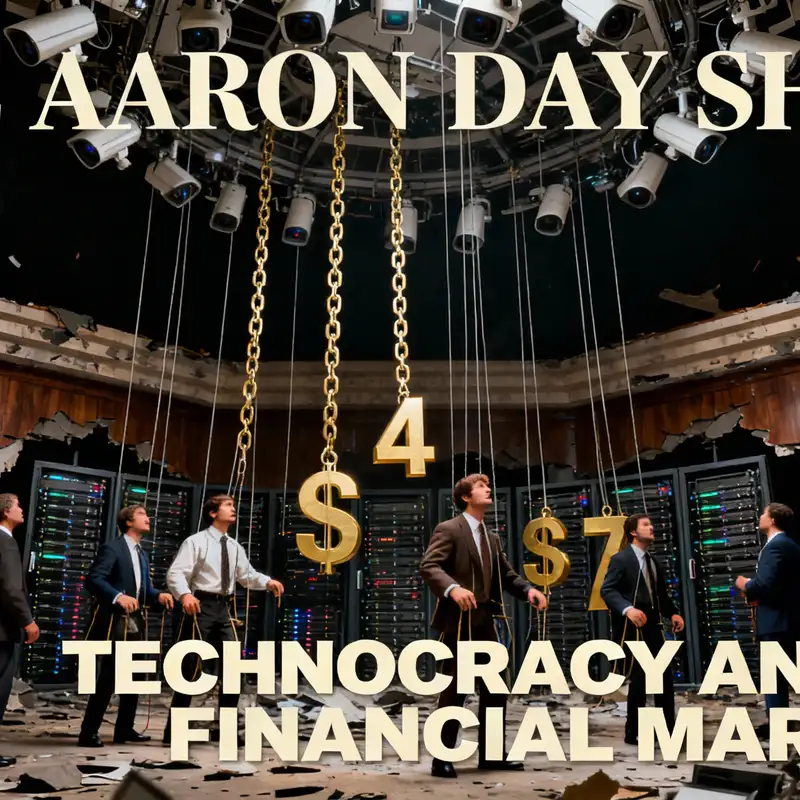
Welcome back to The Aaron Day Show. This is Season Two, Episode Forty-Two. Tonight we have a special guest, Craig Wenkelwitz, who's going to be discussing technocracy and the financial markets. So this should be very timely and a very important conversation, certainly as things are progressing very quickly behind the scenes, even if people aren't aware of it. uh they need to be so before we jump into that i want to just do some housekeeping and and talk about the last few episodes and also speak a little bit about the experience that we had at the brownstone institute event this weekend uh if you didn't catch the last episode it's an incredibly important one i i gave an advanced preview of oasara which is our global medical tourism marketplace And I had an opportunity to actually show this to people live in Salt Lake City this weekend. This is an example of exactly the kind of thing that we need to be doing to counter technocracy, which is to build counters to technocracy, to build new systems and new ways of doing things outside of this dystopian digital prison system. And so essentially this OSARA site has at the present time, five hundred and eighteen different global locations that you can go to for medical services. And as I've been discussing the last several episodes, you can get better health care at about an eighty percent discount if you shop around and do your research. on a whole variety of healthcare related issues. It's not just cosmetic surgery anymore, which is what a lot of people think of when they think of medical tourism. You can actually get, for instance, in India, complex cardiovascular surgery for two thousand dollars and it has a better outcome rate than the Mayo Clinic and the Cleveland Clinic. There are hotspots in regions all over the world. It turns out Thailand is now leading the globe with eight point seven billion dollars a year in medical tourism. There are pockets in places in, for instance, Mexico, a place called Molar City, where there are, I think, five hundred and thirty or three hundred and fifty. You might have those reversed dentists in a in a town that only has five thousand people. It has the highest concentration of dentists on Earth. And what a lot of people think is that, well, if I'm doing medical tourism, these are flunkies from medical school or people that went to substandard places for their education. But what's actually happening and has been happening for a couple of decades is really good doctors that are interested in helping patients realize that they can't do that within the constraints of the American Medical Association, within the constraints of the insurance system, and then the fact that we now have the medical malpractice and the way that the entire structure is incentivized. And so these quality doctors are leaving to go where they can actually practice medicine. So oftentimes you may go to Thailand or you may go to India or you may go to Turkey or you may go to Costa Rica and you're actually the doctors actually trained at Johns Hopkins or Harvard and finally figured out how it worked and decided to exit the system. We're going to be launching this publicly. I could launch it now, but we're going to do a real exhaustive examination of the content that we have in there and do a lot of testing because I don't want to put something like this out without making sure the information is fully accurate. But we're going to put this out this month, and I think it's a great starting point. One of the things that we're going to do is we're going to encourage people to send a link to... We'll have an automatic, or we already have a... a link to email the facility and the doctor about accepting Zaino and Freedom Dollar. And this is actually really important because as it turns out, as I've been researching medical payments, if you're trying to use your credit card or even your bank, and I can certainly envision a situation in the future where you're using a regulated stablecoin and you're trying to buy these medical services, let's say you're trying to buy a twenty five thousand dollar surgery to replace a hip or something, those transactions may be denied. PayPal has been known notorious for doing this. Credit card companies are notorious for doing this. So there is a massive use case for people to start using Freedom Dollar and Zeno today. And this is beneficial for parties on both sides to make sure that the transaction can actually get done. And on the side of the medical provider, they have to deal with a lot of credit card chargebacks. and other issues. And so this is a tailor-made scenario. But rather than try to convince these medical facilities to sign up in advance, what we decided to do is to create the best global resource and website for information about medical tourism. uh about transparent clear in you know information about outcomes the best interface for searching about this the best guides to understanding how medical tourism works what all the checklists are what you need to look out for and building in things like reputation management systems we wanted to start with that and then use that as a way to push and make the medical providers aware of xeno and freedom dollar so that's that's the strategy that we're taking taking with that so Anyway, check out that episode because I did walk through a very brief demo on this. And there'll be a lot of visual improvements and everything before the final launch later this month. The episode before that, season two, episode forty, I really went in and made the case for medical tourism. And actually, as I was researching this episode, even I was floored. I've been talking about medical tourism. for years, but I wasn't aware of the fact that it was now a hundred billion dollar a year industry growing at twenty five percent a year. And so in the process of really understanding how this works, I laid out in this episode where the pockets are. And I gave the specific case studies of, all right, if you're looking for this kind of treatment, this is where to go. And this is how much you can expect to save. These are the quality outcomes, et cetera. So if you want to get a refresher or not a refresher, but a quick update and understanding of what medical tourism is all about, check out that episode or at least check out the first, you know, forty five minutes of it. I think that might might have been one of the five or six hour podcasts. And then the episode before that, season two, episode thirty nine, wasn't actually Mike Adams. We're going to have Mike on next week. But we did talk about the uncensorable AI revolution. And I made the case and this came up. This is one of the big takeaways I have from this Brownstone event. is that we have a situation where a lot of people are saying AI is a bubble or where they're afraid of AI and therefore not embracing it. And so whether you like it or not, AI is here. My argument is that AI will be a thousand times more impactful than the dot-com era. And a lot of people say, well, the dot-com era was a bubble. It was a speculative bubble for Wall Street dumping on retail at the end. But what it actually created were companies that now have a market cap of in excess of five trillion dollars. It was actually a phenomenal success when you look at the amount of money that was invested at the startup stage versus what those companies are worth. And those companies, for better or worse, have completely transformed the economy. So whether we're talking about Google or Amazon or Facebook or any of these companies, everyone is using it either directly or indirectly through things like Amazon Cloud and Google Cloud, etc. I believe the AI revolution will be much more impactful than that. But now the question is, like all of these technologies, you can look at the dot-com era and say, yeah, this is where we got the censorship industrial complex. This is how we now have, this is now morphed into, you know, the beginnings of a digital prison system. But as we talk about often on this show, and in particularly when we're talking about crypto, there's a tyranny side and there's a freedom side. And that is true with AI as well. So I'm going to continue to show and share information with people on how you can use AI to actually improve your consciousness and your free will and to make better decisions by doing things like downloading brightu.ai, Mike Adams' AI that he spent two million dollars training on alternative data sets. with natural health and other information. And if you just saw today, OpenAI has said, ChatGPT will no longer provide medical advice or financial advice or legal advice. So here it comes already. And by the way, the reason that they're doing that isn't because the advice wasn't useful. I'm sure it's because they got profound pressure from the trade associations and because they are completely embedded with operation stargate in rolling out a centralized system where all of our data health and otherwise is being integrated and is the basis essentially for a technocratic system. So it's not surprising that it's going that, excuse me, in that direction, but there is a way out, which is to use systems like mics, which you can download on your own computer and you don't even have to be connected to the internet to use it. So I'm gonna continue to show people things that I'm using and then things that I'm building and things that I learn about so that people can feel empowered instead of afraid. Because those who... fail to interact with these technologies and use them are going to be in a very seriously bad situation moving forward and we'll talk about that more in future future episodes we have the technocracy atlas site technocracyatlas.com is is going to be launching in i think next next week so we're going to have our first ai chat bot where you can take all of this information ten thousand plus articles the content that patrick wood and others have put together plus foundational uh documents on technocracy itself so the idea here is to make this information about technocracy as accessible as possible and that's just the first phase of the technocracy atlas future phases will involve being able to visually map all of the connections and and who's involved with with technocracy Again, you can get Mike Adams AI, self-custody AI at brightu.ai. So I encourage you to, if you can download it, you don't have to download it. You can just use it online without downloading it onto your computer. So there's no... I don't want you to think there's a huge barrier to use it. You can just go to this website and start using it. But I recommend... if you can download it to your computer, kind of like they say with crypto, not your keys, not your coins. If you don't have your crypto in a self-custody wallet that you have in your possession, you really don't own it. I feel the same way moving forward about AI. And I'm very optimistic about the path moving forward. And I'm gonna try to figure out how to communicate that through the six different initiatives and everything that we're doing at Daylight Freedom. because it's complicated to kind of explain all the stuff. But I think these technocrats fighting amongst one another, their approach is that Silicon Valley operates on a winner take all philosophy. And so this is why Mark Zuckerberg is willing to pay a single developer one point five billion dollars. to work on AI, because historically, if you look at what happens, and I realized this because I formed an e-commerce company a week before Amazon in ninety five. And what you find in these big tech battles and Peter Thiel writes about this in zero to one is it's all about, you know, basically creating your own market and owning a monopoly. And that has been the dominant MO of Silicon Valley. And and it works. So a lot of people will say, oh, it's a bubble. Because look at all of these things that failed. But the people that are making the early stage investments in this know maybe only a couple of percent of these investments are going to pan out, but the ones that pan out do like a thousand X or more return. And so this is just the structure and nature of of how this works. The benefit for us is that this is a global battle for the technocracy. So you have companies in China and organizations in China also trying to compete. Everybody's trying to get to AGI. And some of the tactics that they're using against one another include, in the case of China, releasing a lot of their models open source so that you can download them onto your own computer. So we have the ability to benefit from what is massive overinvestment in some cases, or where a lot of these things are going to fail. But some of those technologies are now being put out there on an open source basis. So our ability to take control of our own data and to take advantage of these wars to piece together these technologies is going to give us the ability to, I think, become immune to when ChatGPT decides they're no longer going to provide medical or health or financial advice. So more on that in the future, but I think there is a very optimistic case scenario here. So I'll talk quickly about the Brownstone event in Salt Lake City. So my wife and I, we were one of the sponsors of the event for Daylight Freedom. This is the first event Daylight Freedom has ever, ever sponsored. I mean, we've pretty much just been doing this behind the scenes or whatever, but this was our first kind of splash. And so we unveiled our new branding and everything at Daylight Freedom Foundation to lay out the six different websites and everything that we're trying to do, which is the fundamental idea here is we want to empower free will and expose technocracy, but do this in a variety of different ways where we're promoting cognitive liberty, we're promoting emotional sovereignty, and we're promoting actionable So really we're trying to empower people. There are no white knights, but we do have the ability to take control of our own free will and our own destiny. And we can use some of these tools and techniques to do this. And so we talked a lot about the medical freedom marketplace. Very well received. I was on a panel with Ed Dowd and some others. Jeffrey Tucker moderated the panel. And I think you might have seen some of the clips from it. A couple of them went viral. And because my approach was different than a lot of people at the conference, which is mine is, well, I would say that the two big takeaways from my talk were, that you can either be for Maha or you can be for medical freedom, but you can't be for both. And that rubs some people the wrong way, but it's absolutely true, and I want to explain this. So there are a lot of people in the medical freedom community that got behind Maha. And the idea was, and their thinking was, that, well, if they were successful at winning politically, that what would happen is, and the net result of this would be, People would be given their medical freedom back, the ability to make their own choices in their healthcare. That's what a lot of people thought. But what it's turning out to look like is, Make America Healthy Again is, And I think Bobby Kennedy and others are essentially pushing now a technocratic agenda where their view is, well, we're going to make America healthy and we're going to do this through government. We're going to do this through Palantir Healthcare, Operation Stargate. We're going to do this by collecting genetic information about children. We're going to do this about creating complete surveillance systems and putting in place wearables because we're going to bring together, I mean, this is kind of like an FDR mentality of we're going to build a brain trust and we're going to use the government. to implement solutions to save everybody. And I will tell you, I could not be more fundamentally against a concept than that. This has failed over and over again, and it is the opposite of medical freedom. the government controlling these things and when you dig into and we've talked about this these techno technocracy roundtables when you understand what's going on and how ai is being applied in with insurance in terms of denying claims and now that's being expanded to medicare and medicaid but then when you really start to look at the horrors of what's going on with operation stargate you will understand that that this is not about freedom this is about another group of people who think they're smarter than everybody else and are going to mandate every aspect of our lives. And think about what it means in terms of, oh, now you can't use your EBT card to buy sugary drinks. Well, that may sound great, but that's essentially the beginning of a social credit system. That's the beginning of a top-down system where technocrats are deciding every aspect of your life and every aspect of healthcare. And that is exactly what Maha is actually doing. And so I believe the medical freedom community has been hijacked. I think the medical freedom community doesn't understand that it's been hijacked. It's very controversial for me to talk about, and I'm going to be publishing a series of articles to make the case about this. But of course, at the end of the day, making the case about this is the conclusion isn't vote harder or try to lobby your congressman. The solution to this is to do things like you know, stop asking for permission and stop asking for forgiveness from this public health death cult and start using medical, you know, tourism marketplaces and exercising your own decisions about your own healthcare without regard for what these people claim their authority is over you. Because at the end of the day, You're not going to fix the political process, and I've talked about that over and over again. There's much more about the Brownstone event, but I thought it was a great event and a lot of great takeaways from it. And it was, if you're a subscriber to Epoch Times, you can actually watch, and I don't even know if you have to be a subscriber, I'll see if there are other links, but you can actually watch all of the talks. So they did a great job professionally recording the whole thing. So I thought it was a terrific event and a lot of really great conversations. And I mean, I could talk about Walter Kern gave a great talk the first night of the VIP dinner, just some phenomenal conversations that went on. But to me, again, the pivot here and the most important issues are understanding this Maha versus medical freedom and trying to inspire people to embrace AI or investigate AI, not as something as a control system, but how to use these tools to actually enhance your free will, enhance your consciousness, enhance your ability to basically achieve whatever it is your individual purpose is in life. Just a few more things. We have another technocracy roundtable coming up. I think it's November the nineteenth, I'll have to double check on that. But these technocracy roundtables are great. The last one we did was on on AI. Of course, we have Craig on here with us tonight and Courtney Turner and Patrick Wood and myself are doing those monthly, critically important. And I've just been saying this for a long time. People have to learn about technocracy. If you want to understand what is going on in the world, what's going on with health care, what's going on with things like, you know, CBDCs and regulated stablecoins and now the Clarity Act. If you want to understand what's actually going on there, you need to understand technocracy, which is a ninety year old movement. And it is a ninety year old movement that essentially strips us of individual rights or property rights and moves towards a system where the entire economy is controlled by scientists and engineers and the centerpiece of this technocracy movement is replacing the price-based system of supply and demand with an energy credit-based system or a carbon credit-based system. Well, I'm very excited to announce that Patrick Wood and Courtney Turner just released a brand new book called The Final Betrayal. And I've read about half of it already on the plane ride back. And I will tell you, this is an absolute must read. This book... goes into and very concisely and very clearly explains exactly what is going on right now in ways that people need to understand because there are a lot of people that are glorifying Palantir. There are a lot of people that are glorifying Elon Musk. This book goes in and explains what's going on and explains that, you know, essentially... Peter Thiel is playing five D chess. Peter Thiel is actually kind of a grandmaster at chess, literally, I think he's been playing since he was five or six. It was outlined as it was outlined in the book. And so what is being put in place here, not just with Palantir, but with JD Vance, and some of these other people, which ties into Curtis Jarvin, and this whole dark enlightenment movement, this book lays out exactly what's going on. And this is technocracy. finally being put into implementation after all of these years. And so I'm going to have Courtney and Patrick on to discuss this book. We haven't set the date yet, but hopefully in the next couple of weeks. But I am going to encourage you to either pick up a hard copy. I bought both. So I ordered a hard copy directly from Patrick Wood's website, technocracy.news. So I want to have a physical copy of this with me. I'll put it on my bookshelf once I get it. But I also got a Kindle version. as well, which is what I read on the plane. But I mean, I can already tell you halfway through it, I'm like, okay, this is exactly the information that people need in order to understand concisely what's going on in very relevant, very direct terms. Now, I recommend all of Patrick's other books as well. and also as technocracy boot camp to to truly understand what this movement is about but this book is incredibly actionable because it it takes the movement and puts it into a modern day context and explains what is playing out right in front of our very eyes right this moment and again once you learn it you can't unlearn it so so with that said uh again everything that we're doing here is is about the war of technocracy versus freedom and and again when you understand what technocracy is the reason it's the end of free will itself is that when you can no longer make decisions about your life when you have a social credit system or what you can do on a day-to-day basis is determined by originally the idea was by scientists and engineers but actually the evolution of this is it will be determined by ai ai is kind of the the final end state of of technocracy so what decisions you can make about where you live what you eat what content you have access to literally every aspect of your life will be micromanaged by ai under this technocratic model so this is why this is what's important it's not about republicans or democrats or the us versus china or russia or bricks or any of that none of that matters because it's actually a fight for a global technocracy and And so as I said earlier, the good news is that these technocrats are fighting amongst themselves because they want control. There's the mindset of it's winner take all. So there are cracks here, but then also the opportunity to take this technology and integrate it and develop on it and make it more powerful for individual use. So with that said, I'll bring on Craig Wenkiewicz now to talk about technocracy in the financial markets. And this should be a great conversation and very important work. I'm a big fan of Craig. I don't even know how long ago it was, Craig. Was it a year and a half, a year ago? I don't know. Maybe two years now. It goes fast when you talk about technocracy. Yeah, but Craig's been doing phenomenal work covering the markets for years and years and years and has kind of a particular approach looking at this with harmonics, but then also with kind of a lens on technocracy. So very grateful to have him on and to get his expertise on this and also very much appreciate his participation on this technocracy roundtable. So Craig, thanks for coming on. Good, good. We've got a little bit of an echo here. It's not here now. I'll just keep myself muted when you talk. Maybe we'll see how that goes. All right. Sounds good. Did you happen to see, Aaron, today the deal with Amazon? They inked a thirty eight billion dollar deal with OpenAI for NVIDIA. I did. I did notice that. And then I saw the long list of deals that OpenAI has done. It's a pretty substantial list with NVIDIA and AMD and Oracle and everything else. And this is just another a new thirty eight billion dollar deal. Yeah. Yeah. They come every day. It's amazing. All right. Great. Well, thanks for having me, Aaron. And thanks for the update on that. And congratulations on sponsoring that. That's great. That's a great thing. oh thank you very i'm glad to do it i mean i'm a fellow at the brownstone institute and actually when i talked to jeffrey early on i'm like hey you know um i would love to be a part of brownstone but also i want to i would love to you know ultimately spin off and and do a non-profit focused on uh but what we've been talking about technocracy encounters to technocracy so this is it's great to see that this is kind of finally finally that coming to life Yeah. That's great. Great stuff. I was like, that's awesome. I'm glad you guys are sponsoring it. It's good. So we need to do right. Absolutely. All right. Okay. So what I want to do tonight is go through a perspective from markets and technocracy. And what I like to do when I'm looking at markets is look at them from five different perspectives. So we've got, let me see if I can get this going here. First off, let's just define what, what, at least my perception of what technocracy is and, uh, Aaron's been doing such a great job of covering this. And I've been learning a lot along the way too, over the last, I'd say year, year and a half. That's probably about right. You know, what is technocracy? And how does this tie into the market? So that's what we want to get into tonight. And so just a quick definition of it. It's a system of governance where decision making is guided by technical experts rather than political or market forces. Now, I use something called harmonics, and I believe that it's the natural cycles that are out there. So it's a battle for me. I'm very fascinated by this whole thing because. I use the harmonics and I, and I, I, you know, I couldn't function in the markets without them. And I can see when people are manipulating and trying to push markets around, we've done a bad job, right? Just as a society of allowing too many, too few people to gain too much power, too much money, too many wealth and power transfers, you know, through things like the, you know, two thousand and one NASDAQ bubble, right? The two thousand and eight real estate crisis, you know, The, you know, obviously the repo crisis in twenty nineteen. And then that led, in my opinion, to the covid scam. OK. And so the covid alone was what? Five to seven trillion dollar wealth and power transfer. And so every time that money gets transferred. Right. We basically rack up debt. And that money goes somewhere. OK, obviously, you know, it was paychecks out to everyone and so forth. Right. Basically, you know, a little hors d'oeuvre of what universal basic income would look like. Little handouts. All the money goes out. And then the question is, where does it go from there? And it probably finds its way through the hands of corporate structures and into, you know, the hands of the few. Right. And so when that happens, they get stronger, like the Black Rocks out there. The Black Rocks would be one of the front and center ones. And we've just seen recently where Larry Fink has been appointed to take the place of Klaus Schwab, or I think we had an interim guy in there. I can't remember his name because he was short-lived, but again... crazy looking character right out of like a bond movie or something like that. And then now we have Larry Fink in there and even worse than that, we have the, our central bank, our, our federal reserve could potentially be positioned with Rick reader, right? Most people aren't going to know that name, but Rick reader ran the fixed income at black rock through all these things through the two thousand and eight real estate crisis. Okay. When black rock was basically, um, uh, uh employed okay by the central bank to run a lot of the stuff again aaron talks about this stuff too on the databases and so forth right the central banks federal reserve uses the database system for all the transactions monitoring all this stuff so it's all connected here right that's the big thing is it's all connected and so We're now seeing that we could have Rick Reeder, okay, a BlackRock guy, very smart guy, but I've never been a huge fan. And now that he's on the short list of people to be the next Fed chair, and I want to get into that today too. What is a Federal Reserve? And now that we're seeing it in its later stages, and we'll talk about currencies and fiat currencies in their later stages, and this transition that we're going through, and the question is, You know, what is the power of the Federal Reserve, right? I've been talking about this on my show for the last couple weeks in the mornings. And, you know, the Federal Reserve has a dual mandate, and their dual mandate is price stability with inflation, and their other side of their mandate is maximum employment. And if you think about AI, what's it going to do? It's going to take the power out of the hand of the Federal Reserve, okay? And it's going to sort of strip one of their mandates, which is maximum employment. They're not going to be in control of that. Who's going to be in control of that? The AI, the technocracy, okay? Think about the inflation. Same kind of thing. Today, we're going to talk about commodities, okay, and interest rates and currencies a little bit, right? We're going to touch on these things. Not go too deep, but just kind of skim the surface of the stuff. We can always come back and do deeper dives, you know, upon Aaron. You know, if he wants to dive into something, I'm happy to come back on and dive into some of the stuff with him. But again, think about that. The Federal Reserve is losing its dual mandate. And then we have this character called Stephen Moran, right? He was on the National Economic Council. The Trump administration moved him quickly because he'd already been Senate approved, right, to be in that position. So they moved him quickly to take a position on the FOMC, basically doing a corporate takeover of the Federal Reserve. And so they slid him in there and then they had a couple people, you know, they had Christopher Waller and Michelle Bowman, and they were sort of stacking the deck like you would on a corporate board. OK, so those kind of things we're trying to keep in mind here as we think about this, you know, this technocracy movement. I come from a perspective of these harmonics because I think that's ultimately what drives the markets, right? These natural laws, these natural things that occur in nature, okay, a vibration, right? Things have a vibration. What we can't do is let the technocracy strip that away because they could. They could change the dynamics of this to the point where we could tokenize things and we could take away the freedom of markets, okay? And I'm a believer that we're all connected. Markets are connected. People are connected. We're all connected in some way or another. And if all of a sudden they get control of all those little nodes in between us and the markets and freedom and that kind of stuff, then guess what we get? We get this technocracy. We lose some of this natural law. And what is that? It's stripping away our freedoms and our rights and our God-given freedoms and rights. So that's kind of where I'm coming from on this. And this is the definition of technocracy from where I'm coming from. So let's roll forward here a little bit. In economic terms, it emphasizes the efficiency, sustainability, and the resource optimization over profit. So this is kind of what I'm talking about, right? The natural law, the harmonics of things is kind of the supply and demand, right? What people need, fear and greed, right? The sun rises, the sun sets. When the sun rises, things heat up and we get wind and turbulence and things like that. When the sun sets, everything cools down and things become pretty dormant. It's that kind of thing, right? That rising and setting of the sun, you know, going round and round and round, fear and greed. You know, we go through these cycles and markets and fractals. Fear, then greed, then fear, then greed. We cycle back and forth through all this stuff, and this is that vibration, right, that happens. And we can track that, monitor it, and we can actually use it to project out in the future. But if we let this technocracy take over, from my perspective, that can really start to dissipate. And we've seen, I've seen, I've been watching these markets for thirty-plus years, a hundred and twenty thousand hours, so I've seen this kind of stuff happen. I've watched the transition as we've gone from algorithmic trading to now AI trading. You can see there's different things going on in the markets. They still function like normal, but it's dissipating. It's definitely being stressed from a truth and a natural law type of a perspective. Okay, so let's get rolling here. So we've got... I want to go through this stuff. So market technocracy, I want to look at it in terms of these, right? We've got currency, okay? We've got debt markets. We have energy markets. We have equity stock asset markets. public private side but we'll mostly be thinking about public side here it doesn't really matter public and private still the same kind of phenomenon that goes on there and then we have the commodity markets okay so let's jump in here to the currency markets here so we've got i want to go into this we've got we've got this situation here where we get into these periods of technocratic policy tools all right and this is a way to kind of this is maybe a gauge right aaron does a lot of work too with like uh you know monitoring where we are how much freedom have we lost I want to kind of do the same similar type of assessment tonight with what have we seen going on? And does this kind of fit in that technocracy umbrella? Okay. We see tariffs, right? We had tariffs initially came out, seventy three different countries. Okay. Then we saw trade barriers, right? We saw these things like the section two, thirty two tariffs on steel and aluminum. Okay. And again, we put it under this, this, you know, you know, the quotations of national security. And we do have issues. Right. That was this whole trip that President Trump just took last week over to Asia. A lot of it's about national security. Right. Rare earth metals, rare earth minerals. And, you know, and a lot of things. Right. We were talking they were talking a lot. The the AI chips are supposed to come up. Right. The Blackwell chips versus the H-Twenty NVIDIA chips. That was going to come up. Soybeans was a big thing. You know, we were watching the soybeans to see, like, was this deal going to go through? Because soybeans would be a pretty good indicator of that, right? President Trump was pushing for, you know, the agricultural space. And then the kind of the hidden thing that was there was the defense, all right? You know, when he ended up in Tokyo, there was kind of a couple creepy little clips that came out of him talking about Japan buying our defense supplies. And that's going to be a part of what we're talking about tonight, too, is some of the defense side of this stuff, too. We'll probably just briefly touch upon that. And then, obviously, South Korea. So we've got this Asian rim and this quiet, sneaky little thing of defense that's going on over there. And then we see these issues. Today we saw a clip, and maybe I'll run one of these. I'll have to check with Aaron if these clips actually run. Maybe if you're around, Aaron, let me know because then what we can do is I can check these. I want to see if these clips actually run and they'll push through because I've got three or four of them we can run today. I forgot to ask you that ahead of time. I'm here. I'm here. Okay. Can I test one real quick? Yeah, let's do it. All right, let me test this. Let's just run this one while we're at it. This one, I know I saw this on your post, and I wanted to run this one too. Christine Lagarde, let's see if this plays. I can't hear the audio. Can't hear the audio. Let me try that again. Does that help? No. I know what I need to do to get the audio is I have to share a tab within the browser that I'm using. Otherwise, I've had issues with it. If there's a way to, I mean, the worst case scenario is you can actually play it through your speakers and have it go through your mic. That's not exactly the high-tech way of doing it, but that's plan B. No risk. Yeah, none. All right. We'll get into that. Christine Lagarde. There's a couple of things that President Trump was out talking about after this on the back end of this Asian trip. And then Christine Lagarde also on the energy front. OK, and we could do deep dives on what's going on in Europe. And maybe we'll touch upon that a little bit tonight. But anyway, back to these tariffs. OK, part of this technocracy is. Gaining control over some of these things, okay? I just want to introduce some of these concepts, all right? So we had the section two-thirty-two, right? For national security. Then we had the section three-oh-one investigations, okay? Alleging that unfair technological transfer in practices. So that kind of fits in this realm too, right? And this acted as a trade barrier to imports from China, okay? And then we get these reciprocal tariffs, right? Kind of a baseline tariff. So if you have a tariff on us, we'll put one on you, that kind of a thing. And then we get these non-tariff barriers, investment export control restrictions, which we saw coming through last week. You know, that was a lot of what they were, seemed like that was the real focus of some of these rare earth minerals, right? The export controls. And then we get into things like sanctions, okay? And so sanctions we're talking about so far under this administration, we've seen things like this Global Magnitsky, the Act Human Rights Act, I think it was executive order one, three, eight, one, eight. And then we had this Iran nuclear deal. Okay. That was targeting financial issues, energy, and also shipping and a few other things. Then we had this executive order one, three, eight, seven, one on iron, copper, and steel. That was a big deal out of the gate. Then we had this thing, this CAATSA, it's countering America's adversaries and something else. I can't remember exactly what that one is, but that one was going after Russia, right? Sanctions there. And then we had this ICC, this international criminal court. So we've seen a lot of things on the sanctions front that kind of fit under this technocracy umbrella as well. And then we get currency interventions. Just over the last couple weeks, we've seen things going on in Argentina. Down in South America, it's very active right now. We've got Venezuela's heating up. Brazil's heating up. Colombia's obviously heating up. Again, a lot of this is being pushed upon the drug trade and so forth with Venezuela. in Colombia, but then we also have a lot of things going on down in Argentina. There's this big influence globally that China's been selling their agriculture into South America, and we haven't been. We haven't been selling our agriculture to China, and what does that do? It gives China a lot of influence. So, again, you know, back to how these markets get connected. All right. Hopefully that draws a little bit of a connection of even the agricultural markets are connected to the currency markets, connected to the debt markets, connected to the commodity markets and so forth. All right. But then we have these. And so that currency intervention with Argentina, we saw this twenty billion dollar debt swap currency swap. okay, with Argentina. And we know that this is because the currency, the peso, is in trouble. And I want to get into this tonight a little bit about how these currencies, as we transition out of these fiat currencies into some other form of currency, which we can almost inevitably see is coming, okay? Because with technology, this old form of currency is probably going to go by the wayside. The question is, how does it go by the wayside, right? And I have a little bit different thought on how this can happen. I want to kind of Go through that tonight. But back to Argentina. Twenty billion dollar swap out of the U.S. And people were getting frustrated over this, right? Farmers were throwing fits, saying, wait a minute. How are you funding Argentina when Argentina is selling all their agriculture to China and China's not buying ours? You're just subsidizing Argentina and so forth, right? So this goes into a lot of this, you know, control, right? You know, this... I wouldn't call it monarchy control, but I would call this some form of control. And again, it's all masked in defense. And it might be. A lot of it is in defense. We don't know. We don't get a lot of the reports as to what's really going on. We don't know that every one of those boats really has drugs in them and so forth, okay? But we do know that, you know, we do know the influence that currency has. We do know the influence that the purchase and selling of these agricultural products and so forth can have. So we, Scott Bassan, our treasury secretary, offered a twenty billion dollar debt swap a currency swap with argentina and then they put together another twenty billion dollar package for the private banking private banks to come in and backstop some of it too this is a lot of what we're seeing too with when we come in with like intel right intel Intel was kind of on the ropes a couple months ago. I'd say, what, June, July. Intel looked like it could potentially just fade away into the distance. Then all of a sudden, the government got behind it, took a nine point nine percent stake in it. And then what did the government do? They came in with Nvidia and they said, hey, Nvidia, you need to invest in Intel. And Nvidia and they probably explained it and they probably sat down and figured out this is actually good for us because it brings chip manufacturing, you know, foundry, the more advanced chip manufacturing back into the U.S., not just in Taiwan. And with that, the NVIDIA gains control, the technocracy gains control, and it's the same kind of a thing here if you think about it with this currency, okay? The US goes into Argentina, does a currency swap, And they come in and they say to the private banks, to the public banks, right? JP Morgan and some of these others, you know, can you guys offer lending facilities and so forth? And we don't know what all the structure of this is, but they were kind of balking on it, right? To some degree. But you can see this is how that technocracy kind of creeps, right? The government takes the lead role and then they coerce other companies to follow in their footsteps, right? And kind of help push things through, right? So it's this kind of, I wouldn't call it a public-private partnership, but it's sort of like that, right? Sort of like a public-private partnership. Okay, so it gives a little bit of background on the currency side of stuff. And then we've got payment system infrastructure. We think back to PayPal, the original PayPal mafia. I've been on with Aaron. I'm sure he's covered this extensively. And I know there's intention to cover more because we've even talked about it with where is this PayPal mafia and where have they all gone, right? Where have they all branched off to? And a lot of them are in this whole space, this payment system, whether it's the tokenization, the coins, the technology, they're out in this space, right? They haven't gone away. Most of them are still circulating out there, running other companies, doing other things, okay? And there's quite a few of them, and they're out and about, right? And so we see this, and in this in this currency technocracy space, right? So we're kind of bridging this currency in the technocracy. All right, so let me move on here. Let's get to this next slide. So we've got, let's see, what do we have here? We've got, okay, so here's what comes with So when this global currency system is under some kind of a structural pressure, and that's what comes from the stuff before, right? Like we were talking about, you know, we've got these tariffs, we've got these trade barriers, we've got the non-tariff barriers, right? The sanctions, the currency interventions, the payment system infrastructure. When we get that, we get more volatility in the currency markets, right? We get increasing structural risk around the world, okay? We get, let me see what else we have on here. We can just put them all out here. A wider array of events to monitor. That makes sense. Currency kind of has its place, but it's getting a little bit stretched out, right? Normally, currency is really based around trade and interest rates. And now we're getting more geopolitical risk and other things that are out there. We always have geopolitical risk, but with these tariffs, it increases, right? Just an increase in this. Then we get geopolitical tensions. And as well, I just want to make sure I've got this. Okay, let me get all those out there. I think, let me go back to this. Okay, here we go. So we got it all up there. All right. So we have the increased structural risk, more volatility in the currency markets, a wider array of events to monitor. Okay, with all this technocracy, all these activities are taking place, right? Under the guise of national defense, and again, a lot of it probably is, but some of it may not be. And there might be longer-lasting intentions out of some of this. Okay, so then we get this clearly approaching transition period. And we can see this this week, and that was a clip that I was going to run there with Christine Lagarde, the European Central Bank, in the statement that they're going full force ahead with the digital currency. And they say by twenty twenty nine, they can have it fully implemented. So that means what does that look like in twenty six, twenty seven, twenty eight means probably some kind of a ramping up. And where will they start? That's some of the stuff we're going to be watching for, too, as we watch this thing unfold. Why do we care about Europe? Europe's in deep economic trouble. OK, and what do they normally do? They go to war. So that's why we're watching this, you know, geopolitical risks and tensions. OK. Things like obvious things that are out there right now. Russia, Ukraine, this Asian rim we were talking about, you know, the trip last week. And that underlying thing I was talking about, you know, the defense part of it, right? That briefly gets talked about, but it's really not the focus. But we know that Taiwan is a big deal, okay, to China. China wants to get Taiwan involved. And Taiwan obviously produces a lot of these chips. They, the world would be in big trouble if Taiwan got taken over by China. Okay. And so that was a big part of this trip, I think, is laying the groundwork for President Trump saying to Japan, we're going to protect you no matter what. You just call us if you have anything. I think that was pretty much his direct quote. If you need anything at all, you just call us, is basically what he said. Similar kind of a thing in South Korea. So the point here is the currency, right? What impacts currency around the world, right? Trade fragmentation, global systems that can break into smaller payment blocks, right? If you start losing the global structure as it is, we could get these trade blocks that we're so used to, the dollar, the euro. The euro could break apart very easily here in the near future. It's a very flawed system. Common currency, but all the participants in there have their own debt markets. So it's a very flawed system. So we could see these big trade blocks, these big currencies that sit over these trade blocks be broken into... smaller systems okay more volatile and and it would be a pretty volatile transition into some kind of a a one a currency but two some kind of a payment system how's this going to transition You know, we could spend days on that, okay? But all we're trying to do is just kind of hit the surface of some of these things. You know, the currency, volatility, the trade fragmentation that's occurring, the geopolitical risk intentions that we know are out there, right? Russia, Ukraine, the Asian Rim, Middle East, Israel. Seven wars basically being fought by Israel right now through that whole region. and their partnership with egypt in a lot of ways on the commodity front we'll talk about that we get to the energy space in a little bit all right and then we have south america this venezuela thing where president trump was just out yesterday last night i think it was on sixty minutes he was out saying he was asked the question how long does venezuela have you know and he's like i think not very long right with maduro right maduro is going to get displaced okay so it's going to be some kind of a coup d'etat down there and the question is what are they after so We can just look at this from a geopolitical or we can keep in mind the technocracy of this, okay? What's going on from a technocracy perspective? An