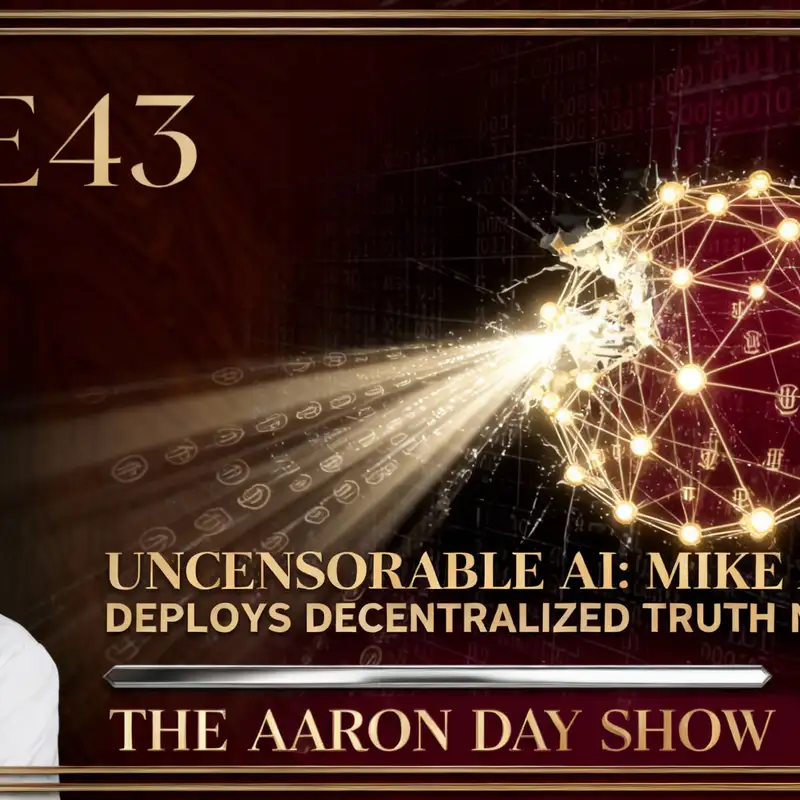
S2E43 Uncensorable AI Revolution - Mike Adams Deploys Decentralized Truth Networks
Welcome back to The Aaron Day Show. This is season two, episode forty three. This is a very special episode with Mike Adams, who is joining us live. We are at an earlier time than usual. The Aaron Day Show is usually at six p.m. on Monday and Thursday. But this is a terrific opportunity to talk to Mike live and I know the timing is a little bit different, but I do encourage you, if you are watching this now, to like and share so that we can get the view count up. Certainly, we'll be spending a lot of time promoting this episode after the fact as well because tonight's topic is an incredibly important topic. If you are familiar with the Aaron Day show, then you are already very familiar with Mike Adams. I talked about him very well. He's been on the show before and also have been talking about him basically every episode for the last few months or so since he released his new A.I., which you can download at brightu.ai i highly recommend that you do that if you haven't already this is an opportunity for you to have an ai in your own self-custody not connected to the internet that has been trained on real information unlike the major models so trained on everything from uh you know alternative medicine to a whole host of of other data sources which i'm sure mike will explain in greater detail But I have been on this show, at least for the last few weeks, interacting with the AI live. So people have been coming on board and asking questions. And originally it started out, people would just ask me generic questions and then I'd type it into the AI and read the answers. And then I built an interface to be able to chat with the AI and we could actually play back audio and video. So we've been having some fun with that as well. So you can download the AI. yourself. But in any event, in the interest of time, I'll bring Mike up right now. And because there's so much to cover that I'm sure we'll run out of time. But Mike, how are you? Aaron is awesome to join you. Thanks for having me on. I've been looking forward to this for a long time. And I love your work, by the way, love what you're doing. I really want to say that I really appreciate you using RAI to help augment some of what you're doing. I'm just going to tell you. It's going to be fun. Absolutely. So the last video that we played at the intro is something that you just released this morning, I believe. Yeah. And it's a very poignant video. Do you want to describe kind of what went on behind that, what your thinking was in putting that out? Yeah, I wrote that for this appearance, but of course I release it separately. It's called The Replacements. And I assume we're going to be talking about this theme quite a bit here because you and I both know, Aaron, you and I, we talk to frontier model developers. We see what's happening in the labs, in the frontier model companies. And You and I know, and I think most of your audience knows, that AI is so much further ahead than what the public understands or what the politicians understand. We are way beyond predictive word, fill-in-the-blank types of models. We are at cognition, really advanced cognition, hierarchical understanding of the semantics of language, meaning, content, reorganization, summarization, expansion, translation, all of it. These AI models are incredibly smart right now. And as a result, Aaron, they're going to replace So many jobs. In America alone, there's going to be a day, although it's a couple of years off, where the unemployment rate in America will exceed fifty percent. And even right now in customer service jobs, for example, even Goldman Sachs just put out a report talking about how probably seventy eight percent of those jobs can be replaced by AI that exists today. and you go across all these industries, as you know, well, in fact, Goldman Sachs concluded, twenty-five percent of the desk jobs could be replaced right now. In a year, you know what's happening to these AI models, how much more advanced they're becoming. In a year, there's potential for a fifty percent replacement of desk jobs. And you fast forward three years or four or five years, then it's the labor jobs with the robots that will have huge replacement rates for transportation, driving, agriculture. You know, we're going to have robot crop pickers, you know, in the fields picking the foods. and the question is what's going to happen to all the humans so that song called the replacements is about that scenario because it will lead to a wave of financial institutions collapsing that is in the very near future there you go um that that's well said but and actually there is this disconnect there's a huge disconnect with the public i was just at a brownstone institute event and and i would consider the brownstone institute to be pretty cutting edge in terms of a lot of different areas but there was an overarching theme that i would say was was anti-ai but also um there was skepticism about ai's capability and then there's another arc to this, which is there are a lot of people trying to push this idea that AI is a bubble, and then they compare it to the dot-com bubble. They're saying things like, well, this is even worse than the dot-com bubble. And I was on a panel with Ed Dowd and a few others, and I brought up a couple of points. while overall the dot-com bubble there was a lot of carnage this is part of that creative destruction process and if you look at you know twenty years later what's happened the largest most important companies whether you like them or not came out of that era And so yes, people were investing wildly in things like pets.com and some things that made no sense. Well, that wasn't a function of the technology being bad. But what we got out of that whole era is we have Amazon, we have Facebook, we have all of these other companies, Google that people use on a daily basis. So even making that comparison to me, it doesn't make sense. But beyond that, as a result of just calling it a bubble, they are basically shying away from even using it. So there's this attitude of, well, the whole thing is going to implode. Nobody's going to be using this. So I don't have anything to worry about. And to me, this is a big error. And something that I've been trying to do is to raise people's awareness to the fact that AI is inevitable. It's here. But it's similar to the situation that we have with digital currencies. Are we going to have a freedom version of it or a tyranny version of it? I mean, what do you think of that assessment? Well, I think your assessment is spot on, and I share your conclusions here. So it's critical to understand that there may be AI-based stocks that are overpriced right now, which I don't even track the stocks because I don't buy stocks. I don't own any stocks. I buy gold and silver and crypto, and I invest in technology like we're doing. So I don't own any stocks. Yeah, could there be a correction in the stock price? Yeah, probably. Is Nvidia worth five trillion dollars? Maybe. The thing is, I alone, my company alone will spend hundreds of thousands of dollars on Nvidia hardware this year. And Nvidia can't make it fast enough because the demand is like five hundred percent more than their production. So it's hard to call that a bubble. You know, if there's a bubble, there would be a glut of products that people don't want. And if you look back at the dot-com bubble, which I called out at the time, I predicted it in advance and warned people about it. You had all these eyeballs on websites like drcoop.com or whatever, and they had these crazy high valuations, but those sites weren't solving real-world problems at all. They weren't doing anything. You couldn't make an argument that people coming to this website and seeing the website solve some kind of problem in society. Whereas today with AI, like for example, if you go to our AI engine, brightu.ai, I wrote that code using AI. I did it as an experiment to see if I could skip my entire R&D team and just build a site myself with all the APIs and everything and just using vibe coding. And it worked. So AI today replaces engineers. It replaces paralegals. It replaces customer support reps. And it does so incredibly effectively. In fact, I've seen studies. This one study, I think, was a joint study out of MIT and Harvard. that showed that doctors reading x-rays and looking for signs of cancer, you know, chest x-rays or lung cancer, that the doctors alone without AI augmentation, I think their accuracy was somewhere around seventy two percent with the diagnosis. with AI augmentation that went up to seventy four percent. But if you take the doctor out of the equation, then the accuracy of the AI alone, I think, was ninety two percent. So humans in many areas actually contribute. And I know this is going to trigger some people. Humans contribute what we call negative cognition in many areas. And again, I know that's offensive to a lot of people because you always think you're smarter than the machines. That is no longer the case. I mean, Aaron, I even say, I'm the health ranger. I've taught health and nutrition for twenty five years. I'm kind of like a walking encyclopedia of nutrition information. I know nothing compared to the engine that we put out. The engine knows more than me, obviously, and it knows more about nutrition and health than any doctor living today or any doctor that has ever lived in the history of planet Earth. And it's free. I mean, it's at your fingertips. We've got it running on phones. We've got it running on laptops, okay? You've got a compressed version of all the world's information at your fingertips. And the cognition demonstrated by these engines is absolutely superior to most entry-level workers' brains. demonstrations of cognition today. So, so the difference, Aaron, just, just to summarize that is yeah.com boom. Didn't contribute anything to the world. Didn't achieve anything. Didn't build anything. Didn't do anything. That's why it was overpriced, except it built out a lot of infrastructure. The AI boom right now is actually demonstrating high levels of cognition, development achievement, and it's here to stay. And yeah, go ahead, Aaron. No, go ahead, Albert. I'm pro-human, just to be clear. I'm not saying let's replace all the humans. My song is a warning about what's coming, that we have to learn to use AI in order to up our game. And even in my own company right now, if I were hiring people, which I'm not at the moment, but if I were hiring middle managers, I would not hire a person who wasn't using AI daily. I would not hire a person who wasn't willing to learn vibe coding. no matter what their role. So the people that are going to do the best in this new economy are people who learn how to use these tools to augment their own human intelligence. Because anytime you turn on AI and you work with it, your IQ goes up about twenty points. And that's what I want in my company. I want people who have augmented intelligence, who still have that human innovation, the creativity, the passion, the morals, the philosophy that we believe in, pro-human freedom and decentralization. But they need to use the machines to augment their productivity. Otherwise, you're obsolete. I agree with that a hundred percent and I actually I started when I had you on a long time ago or maybe I was on on your podcast we were talking about the NVIDIA DGX Spark which is the little mini supercomputer and this was before it was out I think it was earlier this year they announced it and then there was a wait list and it took a long time yeah so I just got mine a couple of weeks or so ago but but it's a game changer and what you find is once you start using them i mean you know we've launched six sites i've done all of the coding there's no one else involved at all and then the more time you spend on it you refine your processes and you understand how this works and you get your environment set up i'm seeing exponentially increasing productivity gains the more time that I spend doing it. I mean, to the point where I actually took that computer in my Mac studio with me to Salt Lake City and did a whole bunch of work and knocked out a new project while I was on the road. That's how intense this is. And what I try to explain to people, so I see two different models happening here. And so there are people that will say and they'll share the news that, Some kid was using chat GPT as a therapist. And after four weeks of interacting with chat GPT, that person was nudged into killing themselves, and therefore all AI is bad. Yeah, well, how many cancer patients go to a doctor or an oncologist and they're convinced to kill themselves with chemotherapy? Hundreds of thousands a year in America alone. So every time people tell me, well, AI is not perfect in medicine, have you talked to human doctors? Because they suck. Well, that's absolutely true. But then I also say, so there is this dividing line between the big tech models and models like what you have, which I know it's not Enoch anymore. Or to confuse the domain names, it's brightu.ai is where you can download it. What matters is what data are you pulling from and then which model are you using to interact with that data? And then is there some other layer on top of that that's further filtering it? And so when you take companies like anthropic or open ai you know open that you know they trained this on reddit and they train these models on like the on the general internet well if you're training it on slop you're you potentially will have um a bad outcome right um but at the same time these models can be very good for coding claude is great for coding but claude censors me half of the time when I'm actually trying to pull content out of it. And it becomes the situation where you're using the AI as you learn which models are good. Yeah, I know somebody's saying, I have been muting when Mike speaks, that's what I've been trying to do. But anyway, you end up learning which models to use in which circumstance. If your approach is, I'm just going to use a big tech model and I'm going to assume that what comes out of it is accurate, That's a poor approach, but that's also a poor approach in life. That would be like buying a singular book and then assuming that that's the sole source of knowledge. I look at this kind of as we build our own personal libraries and those libraries expand over time. You can also build your own library of data that you can then plug into an AI. And so it's an evolving and learning process. process. And I think people need to understand, understand that as opposed to, I think the best analogy I heard is that in the worst technocratic big tech case, we go from being the remote control controlling the TV to being the TV itself, which is certainly a possibility. Or it could be the other way around where we are significantly more empowered by exercising our own judgment over the data that goes in and which models that we're using to solve various problems. OK, well said. A lot to explore there. I'll try not to talk when you're talking because of the audio feedback. I'll try to segment it. But the way this is going in the future is everybody watching this, you need to collect a massive corpus of your own context. So you need to collect PDF files or other text files, whatever, of the books that you like, the content that you like, the articles that you like. And you need to store this locally. because the context window that models support is continuing to increase dramatically. And the way that local AI models are going to be able to work in the future is with RAG augmentation of a large amount of local knowledge. Now, what we've done with our model, which the current flavor is called Enoch, but it's at brightu.ai, and it won't be called Enoch. We're going to release a new model in twenty twenty six that's just called Brighteon AI. But what we did there, as you can tell, when you download the model and start talking to it out of the box, it's already extremely well-trained on health and nutrition. It'll tell you about the dangers of vaccines. It'll tell you about the history of false flags. It'll tell you about inflation and fiat currency printing and all of that. It's trained on over ten thousand books that I personally curated, plus hundreds of millions of pages of content that I curated over the last couple of years. And that's why it works out of the box without a rag layer. It doesn't have to have any wrappers or layers at all. It's just out of the box. You just give it a standard system prompt and it's amazing. People are using it for all kinds of things. I've got people using it, using like, They're using Claw to write local code that talks to our engine using an API from something like LM Studio. And they're using it to write papers, to do research. And I've used it that way as well. So it's a very robust model that took us about two years, Aaron, to figure out how to retrain the base models in order to do that. And just for your audience, the current base model that we're using there that we heavily modified through a number of techniques that we had to develop, we had to write our own code to do these techniques, signal-to-noise ratio analysis of the vector database relationships, et cetera. We use right now Mistral Nemo-XIIb as the base model because we found that Mistral, which is a French company, they have done, in my opinion, the best job on making their models actually trainable. And even then we failed, you know, fifty different ways that did not work or that broke the model and started speaking gibberish or whatever. Finally, we figured out an approach that works, and that's what we now use for all the training that we're doing. And just like you, we have GDX Spark hardware now from NVIDIA. And even though it's not the fastest GPU, it's got large memory, right? So we can train floating point-sixteen models, even larger parameter models, twenty-four B, whatever, on that hardware. It just takes a while, but uh it's all trainable so what we're going to be doing aaron is we're going to keep releasing open source free of charge more and more models that people can download and run locally for local inference and also at the same time our data set continues to expand right now we are going through a classification process of the entirety of every every science paper that's ever been published on this planet in every language And I've forced myself to become very good at handling the storage of hundreds of terabytes of files because it's a nightmare, actually. And I had to switch everything over to Linux, which is great. Linux has been fantastic for this purpose. Windows is useless for any kind of large-scale projects. So everything's Linux. All the custom code now is written by Claude. And I'm the designer of all the code. You know, this is my project, but we're going to be releasing more and more models, all free of charge, all downloadable to promote decentralization of human knowledge and to bypass censorship. So I'm sure your audience, they already know they're very sophisticated. But let me just point this out for any newbies. Once you download a model and you run it locally, number one, no one can censor it. No one can modify it. No one can spy on it. No one can surveil you, okay? The entirety of human knowledge compressed into your pocket, free of charge. Like this has never existed in the history of our world. It's almost like magic, but it's actually math. So there you go, Aaron. Yeah, and I've actually, I've had this similar experience. I mean, I've used Claude to write software to take data from various sources, scrape it online. I actually, Mark Passio has this hard drive called Arc, which has eight thousand books on the occult, plus tens of thousands of audio clips and video clips. And I wrote a program using Claude that uses the best assets of my Mac and the DGX to process in parallel these different formats and put it into what's called a vector database. So then I can call that data using Enoch or using another AI model. And so all of this now is on my local machine. And so this is really empowering. I was trying to show this to people at Brownstone as well, because obviously if you are using the big models, you're not getting a good health information out of them. I mean, and I've showed people this when I first... downloaded enoch onto my computer i'm like oh well what are ten you know top ten natural cures for cancer or whatever immediately spit out uh actual results you cannot do that or you can't get any response or or certainly not anything that's useful other than a whole series of disclaimers coming from the other models, right? And so right away, I'm like, wow, this is great. And then I can plug in other data into that because there's a cutoff point, right? I mean, you train your model up to a certain point, but it doesn't have real-time information. So, okay, well, that's solvable. I can pull information in from Perplexity or from Grok and then run that through Enoch. So you can supplement... the information that you have with any updates or any information that might be necessary that's more real time. And so it's really powerful. And then you get into creating your own workflows and your own type of information. And as I've shown people with the ability to do kind of audio and avatars, you're going to be able to create your own personalized news network based on your life and your information, because a lot of this then becomes feeding your own information into your own system. So now I'm taking all of my podcasts, everything that I've written, everything that I've done and loaded this into the system. And now this is an easy way for me to get access even to my own work. And I'll tell you an area where this is. So I have this setup. So I have I have these six different sites that I'm working on and everything else. And I have these, you know, Claude MD files or whatever. And I have another agent that just goes in and pulls what's going on in real time with all of my projects and then maps that against what the latest news is on AI and including things like drivers or whatever. And it gives me a news report with a bullet list of things that I can do based on the most recent information today to improve all of my projects. Let me show you. Aaron, you and I think so much alike. It's really incredible. Let me show you a screen from my laptop. This is the new censored.news that I wrote using vibe coding. Can we share that screen? Is that cool? Okay. Censored.news, and I want to show you here. We spider, we crawl, you know, eighty different websites that are all independent media websites, including Brownstone right here. And then we use AI prompting to pull out the top trends, as you can see here. These are trends, okay? And then you've got them in food, you've got them in finance, you've got them in tech and energy and everything. You click play here, there's a podcast. And this podcast is, of course, AI generated. And in addition, if I want to analyze something here for the, let's say, I want to know what are the implications of of this like patients are rejecting toxic chemotherapy embracing vitamin c iv therapy mistletoe therapy i can click analyze implications here and then it kicks over to brightu.ai and it runs down a massive implications analysis look here's the here here's the financial implications social and cultural technological uh then medium term and it gives long-term implications shift in healthcare spending etc you know aaron you're not going to get this from cnn you're not going to get it from new york times you're not going to get it from you know any news organization out there and this is the future is ingesting information the way we want it with the analysis that we want with a much deeper understanding that is customized to our particular interests. And that's what I see you doing there. I'm doing it as well. And this entire engine was also built just using nothing but vibe coding. It was an experiment. I mean, I have R&D staff. that keeps brightown.com up and running and things like that, a lot of other projects. But I specifically, Aaron, I chose to bypass the staff for this project as an experiment. And it worked. It worked. So there's your answer. And I'm not firing the engineers. I just want to be clear. I mean, they still work for us on other projects. But this way, as you know, Aaron, when I have an idea... If I'm out jogging or whatever and a cool idea pops in my head, I can come back. I can prompt the system. It can put that feature in. I can roll it out within a few hours instead of taking weeks waiting on other people. So it's a game changer for everything about information. Yeah, it is a game changer. I hadn't coded for like thirty years. When I started my first company, I was doing some coding and then I took more of the CEO business role and strategy role. But we had a lot of developers and I've actually realized that it is easier and it's actually somewhat of a problem because it's easier to interact directly with the vibe coding system with these different models than it would be. It's faster than translating the requirements and giving it to somebody else to do. And actually to the point where it's become problematic because I haven't figured out yet quite how to hand some of these things off because you will actually lose significant efficiency. But it's not that much of a problem other than to say this is how much of a productivity game changer this is. And then I also want to add that what I learned in the process, so I was experimenting, as I told you yesterday, with the idea of creating a multi-agent system that creates a book. So you have like one agent that creates the outline and another comes out that pulls out the research and then assembles it. And then you do kind of an editing process. So you have like seven different agents that are going through these different processes. And in the process of even designing the agents, it gets you to think about well how what is the actual process that i'm going through when i do my writing and is there something i could be doing better even in the way that i was doing things before trying to add ai into the picture and so it really has caused me to think well why do i do this why do i do this is there a better way to do this and i find that when i take an approach to any problem where i start with humility and i realize that whatever it is i think i might know There are other ways out there. And I try to always keep that in mind every time I'm doing something, which is to not presume that I know everything. I might know something, but I don't know everything. And taking that approach is really liberating because rather than trying to prove or just use the thing to do whatever the action is based on your limited set of knowledge, it opens you up to new knowledge. And in the process, you even change your own thinking process. This is the exact opposite of what people worry about when they say, well, we're going to be controlled by the AIs. We're essentially going to become passive and the AIs are going to be controlling us. It could go in that direction. Again, there's a freedom versus tyranny aspect, but at the same time, this can be a game changer that, you know, not only a hundred X is your productivity, but it does, as you mentioned, it adds twenty IQ points, but it does change the way you perceive the rest of the world outside of even interacting with these digital systems. Well, I want to say, Aaron, I agree with everything you just said. And to all of your viewers, I would say, if you're using AI and it makes you feel dumb, you're using it wrong. If you're using AI and it forces you to be smarter, now you're talking. That's the correct way to use it. Because as you just described, Aaron, when you're engaged in vibe coding projects, first of all, you have to clean up your own thinking process. You have to have a much deeper understanding of the process that's required to create a book. And you have to break it down step by step, which a lot of people have not done before. And what I've found is I've seen a lot of online videos of people saying, oh, you know, all AI sucks. It all fails. The vibe coding doesn't work. It fails. And my answer is you suck at prompting. You know, honestly, you've got to be a better prompter. And, you know, it's so funny. Even just yesterday, I... I've been studying advanced prompting techniques and I learned about a new one that I don't even want to mention here because I'd never heard of this before. I went back and I tried it and I couldn't believe, I couldn't believe what it did. It took a process that in our own internal experience, Content generation used to be seven steps, used to take many, many minutes, and it compressed it down to a single prompt. And it did all these seven steps in one prompt in a non-reasoning engine, and I couldn't believe it. I had no idea that the engine was that capable, but it just proved to me that we are so far beyond word prediction analysis. We are into the realm of really functional intelligence. and people who don't know that are going to be left behind in a horrible way and and culturally let me let me mention this culturally and you know i i mean i lived in taiwan i i speak conversational chinese i have strong ties to the taiwan technology community and culturally countries like taiwan and china and even india are super excited about ai and they are deploying it everywhere And yet it's Western countries like America where there's all this skepticism about AI. And there's all this fear about AI, like it's gonna take us over, it's gonna control us. And I say, Only if you let it, you have to become the master of the AI. And you can do that if you learn how to keep it in check and also how to prompt it, how to leverage it, and how to adapt your own career, your own interests, your own ingestion of information, your own knowledge. You will become smarter. You will become more effective. And you can launch a thousand different businesses if you just understand that you can ask AI to help you. There's a joke, Aaron. You'll appreciate this. And I was doing a podcast about how people can download our AI model and use it. And I said, if you don't know what to do, just go online and ask the AI model how to download it and install it because we have a web-based version. And then some people, when I said that to some people, they said, oh, I didn't know you could ask AI that. And I said, you can ask it anything. You can ask it about problems on your iPhone. You can ask it about troubleshooting your clothes dryer. And our model, by the way, I trained it on the instructions for disassembling and reassembling three thousand firearms. So, you know, I mean, there's no limit to what you can ask it. And if you don't know what you can ask AI, just ask AI what you can ask it. See, that's the joke. I mean, people need to just start asking it what their questions are instead of thinking, I can't ask it that. This is weird psychological barrier. I don't know. Maybe you can explain it. I've seen that psychological barrier as well. And so what it is, well, I don't know if this is what it is, is an explanation, possibly not the explanation, but a lot of people that are afraid of technology in general, the way that they approach the problem is that they come up with a strategy for how they think it works. But they're coming at it kind of from a perspective of fear. So when it doesn't work the way that they think it should, They end up getting angry at the AI itself. I've actually seen this happen as well. So this goes back to my earlier point about approaching it from the standpoint of humility and just asking. Because usually what it is, is you need to ask a couple of layers above where you're asking. You're trying to get one particular answer, but you need to just break your question up into layers. smaller and smaller chunks. And a lot of times there's this idea of, well, if I don't get the answer back right away to the question that I'm looking for, it's the AI's fault. But in reality, as you mentioned, it really is all about prompting. Are you really asking the right question? Maybe the question that you think that you're asking isn't even the question that you want answered. You haven't thought through the question well enough. And so I think to this point, if you start breaking these questions down and if you're willing to approach it with humility, and be willing to ask really basic questions and not feel stupid about asking those really basic questions. Can I jump in, Aaron, and add something? Sorry to interrupt, but you can also use meta-prompting, which is you ask the AI engine to write the prompt that would accomplish the following thing. And you can just tell it, you are a great prompt engineer. I need you to write a prompt that's going to help me, you know, crawl a news website and extract the headlines. And how would I write that prompt? Boom. There you go. Then it writes the prompt, right? You take that prompt and you put it back in to Claude or something. And now you're crawling the site. See, you, you, you gotta, just like you said, Aaron, you gotta think levels above this. You can ask it, how do I approach this problem? And, and the way most people look like here, here's an example. Most people are one-shotting AI engines and they're not happy with the answers. Well, would you one-shot a scientist on the street? Like, hey, scientist, you know, what's the answer to this physics problem? And the scientist is, forty-two. Okay, well, maybe that's not the right answer. Maybe if you give that scientist some context, oh, here's the science papers, here's the theories, here's the thing, go crunch this, and the scientist has time, then a little bit later he's going to come back with the right answer. That's the way you've got to work with AI. The one-shot answer is usually not the one you want, especially you've seen this, I'm sure, Aaron, when you're building books. You're building books with AI. You're not going to one-shot a book. Are you kidding me? No. And by the way, my prediction is the book industry – I mean, I'm not trying to trigger people, but the book industry is toast. The book industry is toast. Again, sometimes people get offended when I just tell the truth, you know, but you're not going to go out and buy books. You're just going to ask an engine to give you a book on the topic that you want to learn. I'm talking about nonfiction here, right? But the book industry is toast, right? I mean, do you see it any other way, Aaron? I'm curious. I see it that way as well. In fact, I actually had a call today. I'm working with a group that is taking a small group of authors and taking their information and putting it into and using AI to make twenty page summaries as a way to take complex topics and make it accessible to a wider audience. But to your point, at the end of this process, it becomes completely customized and it becomes completely personalized. That's right. And to this whole issue around fear around AI and that we're going to become dumb as a result. Essentially, we're going to be outsourcing our cognition entirely to these machines. I go back to the fact that Socrates was against writing. Socrates' view was writing would be horrible because we would lose our ability to do oral storytelling and we would lose our ability, our memory would deplete. And then as the printing press was being rolled out, there were people that were anti-printing press saying, well, this printing press is going to result in the mass production of a bunch of slop and then this is going to basically caused brain rot, not the terms being used in the fourteen hundreds. But I mean, essentially that that was it. I've actually been thinking a lot recently about, OK, if I go to read a whole book and you're right, we're talking about nonfiction here. What is my own mental process when I'm reading the book? How do I extract information out of that? And can I get to a way where I can apply whatever that algorithm is to the text so that I can get the information out of it as opposed to having to even go through my own long-form process of reading the entire book? So I've been thinking a lot about reading itself. It's a supervised fine-tuning of bioneurology. Yeah, exactly. That's what it is. Yep. And so and so this so I don't think this is something to be afraid of. I think that I think they're going to be some phenomenal developments. And again, this is going to come down to some people are visual learners. Some people are auditory learners and everything else. Great. You're going to be able to customize that front end for how you get access. Yes. I think it's just going to be it's an absolute game changer. And people are holding on to this as if, well. Reading is the big thing, as if it wasn't a technology, as if book publishing wasn't a technology, right? There's a gap here in the way people are thinking about this, and it's just because this is what they're accustomed to and they feel threatened by it. But clearly, it's going to transform the book. I'm working on my own book, and I'm kind of like, yeah, it's taking me a while. It's taking me actually a long time because... the point of the book is going to be to promote action. So these websites that I'm creating, it's about, you know, not just, you know, here's all the scary stuff about technocracy. Here's, here's what you can actually do about it. And so there's a lot of forth and the websites change. And so I'm trying to figure out how to extract the data. So the data that I'm putting in there is timeless regardless of how the website changes and everything else. But yeah, it's books and media in general will be completely transformed. Yeah. yeah and i i should clarify uh the book industry as we know it is toast right so i don't mean that books will all vanish in fact i think there will be many more books because you'll be able to instantly generate whatever book you want and just like the process you described people like those that you know and those that i know we will put out digital books that are that are written with the help of ai but have special philosophies and have special actionable knowledge that's built into those books and we will be bypassing traditional publishers i think the the traditional publishing model of one book for the mass audience is that's what's really toast and the process of writing and editing and publishing a book that takes a year that's toast You're going to have instant book generators. And the reason I know that is because I'm going to launch one before the end of this year. And you're going to be able to generate a book at no cost, free of charge on a webpage on any topic you want. And then you'll be able to download it, download the PDF. And if you don't like it, you can generate another one. And you think about it, Aaron, like a recipe books. Does anybody need a recipe book? No. You just ask for the recipe you want. You don't, you don't need a book, right? Does anybody need a how-to book on home repair? No. You ask the engine for that. So what authors need to do, I mean, human authors still have intrinsic value to society. I'm an author. You're an author. But we have to rethink how we communicate that information to consumers of that information, which is exactly what you were talking about. The book format is one format, but you can take a book and using AI agents like what you're putting together there with your Spark hardware, you can take a book and have the book generate a podcast, have the book generate a documentary, have the book generate a PDF executive summary, have the book even become the basis for scientific research using the new Cosmos engine, and it can conduct science research on the science papers based on the premises that you have in your book. a what i call a nugget of knowledge can spawn multiple systems of ingestion it can be an audio podcast it can be a graphic it can be a graphic novel it can be all of these things it can be a series of articles a docu-series whatever it is like you said aaron some people want to learn visually some people You know, some people hands-on, some people want to have three D space. Great. Every piece of knowledge will be available in every format. And AI is going to allow the people who have the knowledge to communicate in all those ways. And it's not going to be writing a book manuscript. That's my point. Yeah, I think that's exactly right. In fact, I spend a lot of my time now... My goal in life wasn't to be an author. I write a book because it's a way to convey information. But I would certainly like to convey information more effectively. And I realized books are... How many people buy books and don't read them? I mean, I think that would be a pretty interesting statistic or only read part of it. And so then it's kind of like, okay, well... What is the right what's the right format even for the book? But, you know, to your point, when I think about content, it's like, well, this content can be in a the format of a meme. If you're thinking about it in terms of you're trying to reach different audiences, it's one idea that you might want to convey. And the way that you would convey that on TikTok is completely different than the way you would convey it online. on X and it's completely different based on what the audience is and what the profile is. And so this is going to allow you. So then the important part becomes, okay, well, what are the ideas that I'm trying to convey? And then you become more efficient about, is this idea that important to convey? You become more economical about your own time, and this is where it sharpens your own thinking. And you know, what's really interesting about what you just said is that memes are ways that humans compress tokens of meanings into images, which is exactly what the new DeepSeek OCR AI model is doing in a little bit different way. So can you compress knowledge into one-tenth of the number of tokens needed to express the text that describes the knowledge using images? The answer is yes. That's the breakthrough of deep seek OCR. But humans have been doing that forever. Cave art, you know, graffiti, memes. We've been doing this forever. It's a natural part of our human neurology. And you're absolutely right. And, you know, possibly text for a lot of people is not going to be the most efficient way in order to conduct that SFT, you know, You know, movies. I think we're going to see AI models that actually think in world renders of three D space. They're actually going to compute in physics. They're going to run simulations as the tokens that produce the thinking like reasoning models that do not reason in language. They're going to reason. in essentially three d space representations of a simulated world and when that happens oh my goodness man you realize i know you realize this aaron because you're on the leading edge of this but when ai models can talk to each other they can develop ideas without stepping it down to human language it's going to be a takeoff point for agi no question about it Yeah, I think that's absolutely true. And you brought up a couple of things. You brought up DeepSeq OCR, which I'm trying to get working on the DJI. One of the things about this NVIDIA thing is that the GPU is so new that it doesn't work with everything yet. So I've learned patience. I'm like, okay, I'll wait for this for a little bit. I'm going to go explore over here. But there are other things going on, such as there's this, do you hear this new Xtropic chip? um that one of the one of the people in the chat mentioned this as well but that works completely differently than this typical token system predict the next word model is that the chunk the chunk thinking chip i i believe that one is the chunk thinking chip okay yeah but you know a lot of llms are already doing more chunk thinking in software without the hardware but you're right i think once the hardware is actually built for that you're going to see a leap i mean Look, the other thing, what that's going to lead to is that the tokens are going to become so inexpensive. You know, what are you paying right now for tokens on an API of an engine? you might be paying a few dollars per million input or output tokens or even less for the smaller models. That's going to drop to pennies and fractions of pennies. And at that point, I mean, I put out a podcast on this very point. I said, look, AI tokens are getting a lot less expensive while the quality of AI output is rising rapidly at the same time that human cognition tokens are becoming more expensive because the cost of living is going up and you know food prices everything that supports a human being so human tokens are going up in price but human tokens are going down in quality and that's i think for a number of reasons including probably the jabs and pollution and heavy metals and all the things that are damaging people's brains so if you wonder why are corporations replacing people with machines there's your answer you know just just draw the lines i mean it's like it's inevitable and that's why i did that song the replacements and society is not tracking this you know even trump is not tracking this yet he will eventually as you have mass bankruptcies of lending institutions because you've got millions of unemployed americans that can no longer pay off their loans i mean you're going to have a banking collapse that's going to make the big short look like a walk in the park if you thought subprime mortgage collapse was bad wait wait till twenty twenty seven you know it's it's gonna get ugly well it's it is already starting to get ugly and it's it's absolutely inevitable it'll probably be a uh controlled demolition in fact but one of the things people ask me all the time because i talk about you know cryptocurrencies and xeno and privacy tokenization and everything one question that people ask me all the time is what should i invest in this is this is one of the top things and my answer I'm not going to go through the normal, well, I'm not a financial advisor. This isn't financial advice. But I do have an answer that has come about in the last few weeks, which is what you should invest in is yourself. You should invest in knowledge. You should invest in figuring out what your purpose is, what your true unique purpose is in life, and what you're really passionate about. And if you don't have the skills for that, acquire knowledge. those skills that is above and beyond the best investment that you can make because you know to put it simply we we live in a society now where people have jobs they don't like to have insurance that keeps them sick so that they can acquire a financial portfolio of companies that are building their digital prison and they don't even own those that basket of of investments and so people are living these lives of quiet desperation the future doesn't have to be this this place of survival and fear it can be we can go on the offense we can take back control of our own life and it starts by figuring out what what you want to do and and then figuring out how you acquire the skills and the knowledge to do that what do you think of that approach a hundred hundred percent because if you realize that your current role in society is likely to become obsolete in the next few years you have this window of opportunity to reinvent yourself And I even did a podcast on this very point. I said, use AI to reinvent yourself. You can do that again. You know how we were just talking, Aaron, about you can ask AI agents anything and just get a competent model. Use our model or use whatever model you like to use. But what you should do is write out a full resume of all your skills and all your interests, everything that you're good at and everything that you'd like to do. Just write it up and then paste that into an AI engine with a prompt that something like, hey, all the jobs we know today are becoming obsolete. Here's my interest and here's my skills. What could I do that would survive the rise of machine cognition and mass job replacement? What kinds of businesses could I start? What kinds of services could I offer? How could I remain relevant in the economy? Boom. And then look at its answer. Take the answer. Give me twenty ideas. Okay, great. It gives you twenty ideas. You go through that. It might trigger another idea of your own. Or you can take the best of the twenty. You take that idea, you feed it back into the AI engine and say, okay, I want to do this. I want you to help me develop a business plan. I want you to assess the risks. I want you to assess the opportunities. And I want you to tell me how good of a fit that this idea is with my skill set. And remember, these are my skills and these are my interests. How will this fit into my lifestyle? Boom. Run that prompt. Get that answer back. Look at the plan. Take the plan. Paste it back in. Say, hey, take this business plan. I don't want you to expand it. I want you to fill in the gaps. I want you to correct the errors. I want you to give an analysis and then be a critic of this business plan. Tell me how this might fail. Tell me what the risk might be. Boom. Run that. Now you have an executive report. You got a good plan or a bad plan. You see where I'm going, Aaron. Essentially, this is recursive reasoning. And use the AI. You don't need to hire a business consultant. Use AI to help you through this process until you get the plan that will help you adapt and advance to stay relevant in this economy. Use AI to help you do that. Very straightforward. And then what you'll find once you co