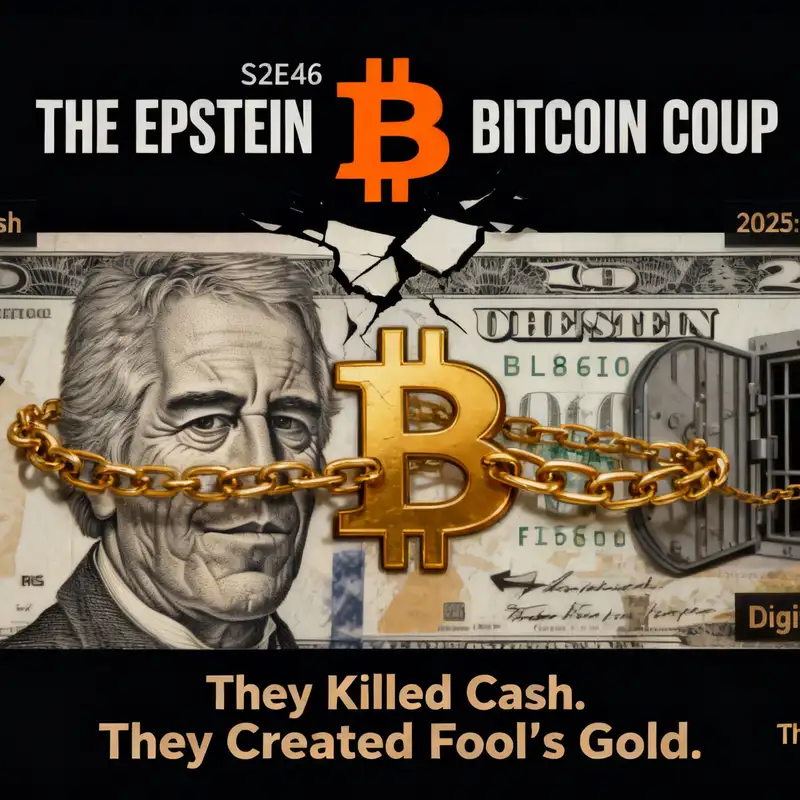
S2E46 The Epstein Bitcoin Coup - From Digital Cash to Fool s Gold
Welcome back to The Aaron Day Show. This is season two, episode forty six. This will be a very interesting episode, although I am traveling. So I'm in a hotel and I'm actually having to use my hotspot again because the Internet here is not sufficient enough even to do a live stream. So hopefully the audio and video will work out it actually i didn't have as much of an opportunity to um get everything prepared for tonight uh and in fact some of the things that i wanted to have to show live are in a earlier state than I would like, but I will nevertheless show you what I have related to this incredibly important topic of the Epstein Bitcoin coup. And if you have been watching this show, excuse me, I have covered this topic from literally day one. And in fact, what I'm going to do is I'm going to pop over to the AaronDayShow.com website, which I recommend you actually watch the show there and comment there, as I suspect censorship will continue to expand on the topics that I'm talking about, namely technocracy. as most of the platforms we distribute through are run by technocrats. So anyway, I've taken a lot of effort to build these sites and then I'm doing everything that I can to make sure that they're censorship resistant and completely decentralized. But tonight's topic is important for a couple of reasons. If you have been paying any attention, which I'm sure you have, the price of Bitcoin has been absolutely cratering and i don't know for sure what all of the causes are for it but i suspect that some of what we're gonna what we're talking about tonight might be part of it and if not it certainly should be I'm going to share now the Aaron Day Show site just to kind of walk through some of the episodes because I'm not going to rehash this. As I was putting this together, I'm like, well, do I really want to do a recap of everything on this? And then I realized I don't want to talk for ten hours on this. But if you go back to the very first podcast that I did with Kurt Walker Jr., season one episode one uh this was actually discussed the hijacking of of bitcoin now kurt's part of the bsv community and so he had a a different a different take on it but so many of the podcasts that i've done have touched on this topic Season one, episode three. So here was the very first one, the crypto revolution, Bitcoin, civil war and the fight against CBDC. So this was literally my first ever podcast. And then and then from there, we continue to talk about these types of issues, including the Craig Wright case, the BSV, BCH thing, all of that. And then episode three was with Roger Ver just three weeks before he was arrested in Spain. to discuss his critically important book, Hijacking Bitcoin. And so since then, everything that I've been doing prior to even having a podcast for the last three years has been to warn people about CBDCs because CBDCs are part of this technocratic threat. So the technocratic threat is that we are, and by the way, it's happening at lightning speed. I hope you've been catching some of these technocracy roundtables. I mean, you have Elon Musk talking about, you know, we're not going to have currency as we know it. We'll have a system based on energy credits. He's talking about universal, you know, not basic income, but super income. This is all out of a technocratic, literally playbook that was developed in the three years ago and CBDCs fit into that. So once I realized what was going on with CBDCs and that CBDCs were part of a larger framework, I dropped everything that I was doing to do two things, to warn people about technocracy and then the part that CBDCs play within that. And then two, to promote alternatives. And the alternatives that I started to promote, if you have the early copy of my book, this is before I was fully immersed in privacy coins. Privacy coins were mentioned, but I was still involved in this whole Bitcoin, which version of Bitcoin is going to be the one that wins out. But even in my book, I discussed the ties and the hijacking of Bitcoin. And my book came out before hijacking Bitcoin, but I discussed... what was going on with the hijacking of Bitcoin from a different perspective than Roger talks about, which was, I talked a lot about what happened at MIT, namely that in doing my research, I found that The Federal Reserve has been working on three CBDC pilots going all the way back to like, so most people, I mean, even as recently as this year, if you saw this testimony and people talking on the floor about trying to pass some anti-CBDC bill, some of the arguments they were using were things like, well, we need to at least research a CBDC so that we can stay competitive with our peers. I'm like, research a CBDC? We started developing one eight years ago. using Bitcoin core developers. So I have been talking about this from the very beginning. And now it came out this week in some of these house leaked emails from Jeffrey Epstein that in fact, because I put this article together in the Brownstone Institute. This was my second article. Let me pop this up. excuse me this is my my second article at the brownstone institute and it was entitled the sinister links between jeffrey epstein cbdc's and bitcoin And in this article I lay out, a lot of what I learned about what was going on with MIT and these CBDCs, because of course I was warning people about CBDCs, but what I found in researching this is, okay, we know that at some point in time, MIT took over and started funding the Bitcoin core developers. We also knew that Jeffrey Epstein funded this broader MIT Multimedia Lab. Now, the MIT Multimedia Lab was involved in a variety of different projects, not just digital currencies. And so I speculated, but without stating that I knew definitively in this article, that I suspect that Epstein directly funded these Bitcoin core developers and then probably by extension later started funding some of these CBDC pilots. And people pushed back and Bitcoin maxis were like, oh, that's a conspiracy theory, blah, blah, blah, blah, blah. And it turns out it's definitively true. And the money explicitly went to these purposes. And so this is now documented. And by the way, these emails and all of this information are now at the technocracyatlas.com website, which now has thirty five point eight million words. I have put not only all of the house emails, I put all of the DOJ information that was released earlier on Epstein and the minute. whatever we get redacted or not from this latest ruling, I'm going to take all of that information and index it and make it searchable using the AI search bot at technocracyatlas.com. As I will show you later on tonight, I'm adding more functionality so that we can go beyond just a chatbot on technocracy to begin doing collaborative investigations, crowdsource investigations. Because I have been sounding the alarm on this the whole time. I've been saying, listen, CBDCs are a threat. But then all of the propaganda and everything that people are pushing out basically came down to, well, Bitcoin is freedom money. Bitcoin is the answer. And I even see it today. I see libertarians saying this. oh, well, you know, Bitcoin fixes this. Bitcoin fixes nothing with respect to freedom. Bitcoin was hijacked every bit as much as Roger described in the book, and then worse, like ten times worse. You basically had Bitcoin hobbled from being Bitcoin Cash to digital gold at the same time, the very same people, even some of the same developers. This developer, Corey Fields, was an early Bitcoin core developer. Then, with funding from Jeffrey Epstein through MIT, began working on SegWit, Lightning, some of the technologies that basically handicapped Bitcoin and made it not usable as digital cash. Then he became one of the co-authors of Project Hamilton. And Project Hamilton is a US retail CBDC pilot. And in fact, it was a successful pilot that the last time I checked, I talked to some people that actually worked on it. It was able to do one point eight million transactions per second. So you have all these Bitcoin maxis saying, well, you know, Bitcoin can only do seven transactions per second, but it should be digital gold. And it's superior because it's decentralized and a whole bunch of other just completely fallacious arguments. Thinking that the Lightning Network was going to fix it when Lightning Network was never going to fix it. This was kind of a complete psyop to buy time to fully develop CBDCs, which would be used as digital cash now. As the story gets even more complicated, yes, we don't have CBDCs, but we have Tether. And some of the very people involved in the hijacking of Bitcoin tied to the Bitcoin Foundation were involved with the founding of Tether. And I suspect also probably involved in connecting Howard Lutnick and others, although I haven't been able to definitively prove that link. So this is massive. News. Oh, can you hear me? I'm seeing somebody saying that my hotspot went down. Can anybody hear me? Usually when it stops, I get some kind of indication. Anyway, please, if you can, in the comments. Can we see? Can you hear me? So in any event, I think the hotspot's working. So I've been very, very adamant about discussing this. And the Maxis, all of whom have blocked me from Michael Saylor to Max Keiser to the guy who wrote the Bitcoin Standard to Adam Back to Luke Dash Jr., core developers, they've all blocked me. Most of them I've never had any direct interaction with. And I mean, this is just an extension of of what Roger talked about in the book. But this is now critically important. Like, I mean, I can't express this enough because I even see in it's become this thing in libertarian circles. Where I'll go to libertarian events and it's this unspoken thing where there are people that have been involved in Bitcoin from very early on that are libertarians that are continuing to spread the misinformation that it's freedom money and they know better. And when you challenge them on it, they're very uncomfortable around it. And then it becomes one of these things, well, we should just not fight over this. Let's not fight over whether or not the thing that was supposed to be the answer to central bank tyranny has been hijacked by Jeffrey Epstein and traditional finance. We can't talk about that. Is this the kind of what we're in polite company now or what we don't want to disturb the power that the libertarians have? Libertarians have no power. If the libertarians had anything, it at least should have been the truth. And this is an ongoing thing. And not that I've been pulling any punches, but I will tell you this. In twenty twenty six, I'm going to be even more vocal about this, more directly vocal about it. I'm going to start calling people out. I'm not going to go to a libertarian event and listen to somebody tell me that Bitcoin is freedom money and just ignore that because people are getting profoundly damaged by this. So. So let's look at what happened. So Roger got arrested three weeks after this book came out, perhaps just a coincidence. But then the timetable from there, this was in like April, three months later, We had this big Bitcoin conference in Tennessee. And then all these politicians come out, Trump and RFK, Cynthia Loomis, and everybody's there. Now they're talking about a Bitcoin strategic reserve. And now they're talking about crypto regulation and everything else. So the absence of people having this information, I don't blame most people for believing what they believe about Bitcoin simply because they've never been presented with alternative information. I mean, I even know, you know, I have a suspicion of how RFK learned about Bitcoin. And it wasn't talking to people that have been on different sides of this discussion. I think a lot of these people went into it and they were sold the propaganda. And they still haven't heard the other perspective. But now this is getting really serious because... with what's going on globally and the rate at which technocracy is moving. And we're talking digital IDs. We'll talk about, which if you haven't, I encourage you to sign up. I think we have over a thousand, registered users now with Technocracy Atlas in just a week. It was very helpful that we launched it. I was on Alex Jones the day we happened to launch just a week or two ago. I don't even know now. Time is kind of blurry. But what I put together here is an analysis to show people visually what's going on with Technocracy. And So the endgame of technocracy is one global government ruled by scientists and engineers, which now has evolved to kind of AI with an energy credit based currency. That's the simplest description. And if you're going to measure how that's going, you're going to look at what's the proliferation of digital IDs? What's the proliferation of digital programmable currency that can be controlled by third parties? And what's going on with AI surveillance? Well, it's a disaster what's going on. I mean, this isn't like something where it's in twenty thirty. This is going to happen. Sixty percent of people in the US have real ID, which is already digital in a lot of states and be a majority of the states by the end of this year. And by twenty twenty seven, the expectation is it will be fully digital everywhere. We have the Genius Act and now the Clarity Act, which is going to be tokenizing not just money, but all of your investment vehicles and everything else, which will be controlled and regulated. So your programmable stocks and ETFs and everything else. And then the massive expansion of Palantir, Operation Stargate, Oracle, OpenAI, all of it. This has happened faster this year than in the previous four years. And globally, you have one hundred and fifty four countries working on CBDCs. Three and a half billion people are already under digital ID or laws have been passed and it's just in the implementation stage. This is this. So this is serious. This is no longer. If you go back and you read the first edition of my book, I was warning people. This is no longer a warning. This is this is a description of things that have already happened. And now I'm putting together things to say, all right, here's the level that it's at. It's kind of like we're at level three out of a five. scale and level five is a complete you know single global government essentially the loss of free will because what decisions you can make on a day-to-day basis in your life will be determined by a social credit system tracked by ai surveillance so this is the severity of what's going on so when people say well don't argue about bitcoin or you don't want to argue it with with you know within the libertarian party about bitcoin this is the issue That libertarians should be talking about. This was the issue at its inception. Bitcoin and the hijacking Bitcoin discussed this. The first phase of this very much was libertarian. It became more mainstream. But to still be a libertarian and to still tell people that this is freedom money is false. It's an outright lie. And there are people in my own community. I'm in New Hampshire as part of the Free State Project. And, you know, one of our state reps just put in a bill for a hundred million dollar municipal bond backed by Bitcoin. Everybody's cheering. It's bullshit. If your whole idea was to separate money and state and now you're cheering on people using the force of the state to buy your surveillance cryptocurrency that Epstein hijacked, you're not a liberty person. This has to be said. There is so much of this collectivism and, well, at least we're all in it together. What, all in it together on going against the very premise of the thing that we were supposed to be working on together? But we're winning? Because what? Because we got a bill that increased the value of our fiat holdings, of a hijacked cryptocurrency? This has to be called out. shouldn't be unity around something like bitcoin and i will tell you well i'll get into this but i mean it's going to get worse because now the way elon musk is describing bitcoin is essentially it's an energy currency i actually see a scenario where they will try to use tether which is a backdoor cbdc it's a programmable fiat and then back it by Bitcoin, which is surveillance digital gold. We're actually going so far away from a currency that you use directly without any government or bank to two levels of surveillance. Your money can effectively be frozen at a couple of different stages in the process. It's the biggest rug pull in financial history and yet still bitcoin maxis and and certain libertarians i call them faux libertarians now because they're not libertarians you're not a libertarian if you're pushing legislation and hiring lobbyists and you know so forth and trying to push the government to steal and or use taxpayer theft to buy an asset it's it's absurd so So anyway, so tonight I'm going to go through at a high level some of the connections here. But more importantly, as I've talked about this, somebody that Bruce Fenton, who I've been a friend of and he's also a freestater, but he was involved with the Bitcoin Foundation when this whole transition happened. And his response to this was this was old news, this Epstein thing. It is not old news. I've been to twenty seven states. My wife and I have been to twenty seven states and four countries. I mean, I ran for president to raise awareness on this issue. I've been all over the place. I don't know how many podcasts I've done. I don't know how many millions of people I've reached. And almost no one knows about this. There are some people within the cryptocurrency. But you know what? But my challenge to you will be and one of the things I'm going to do in this podcast is is give a list of twenty questions you might want to ask during the holidays, Thanksgiving or Christmas or whatever with your friends and with your family and your relatives around the table. If the conversation of Bitcoin comes up and you can ask them whether they've heard about the fact that Epstein was involved in funding these developers, you can ask them if they know that Bitcoin used to be used with retailers as an actual currency. I've got the whole list of very simple. They're simple questions. They're not really complex questions. and i guarantee you almost i mean unless you're like really hardcore in crypto and you've gotten everybody in for years i i'm gonna guess that ninety percent plus have never heard of any of this still to this day this is another tactic that bitcoin maxis try to do they try to deflect they try to push the issue under the rug and i i i mean i'm done with it because we actually We're not going to vote. You're not going to change your congressman. There's no opposition in Congress to this. The Republicans are in on it. Most of them have no idea. Some of the people, this guy Warren Davidson today that put together the... Bitcoin strategic reserve bill. People can now pay their taxes with Bitcoin. And then that'll go into the Bitcoin strategic reserve. The price dropped. That guy's obviously kryptonite. But I've talked to him before. I gave him a copy of my book. These people have no idea in Congress how any of this works. But they've met with lobbying firms. funded by people like the Winklevoss twins, who also wouldn't know liberty if it kicked them in the face. And so they're out there thinking, oh, there's momentum on this thing. And these rich crypto people are saying this. And so they're trying to elevate their status and so forth. And so they think they're doing this great American patriotic thing. And it's just a gigantic thing. psyop so um in any event there's there's a lot to to go through here and you know i'll do my the normal recap of the last couple of events i will say i'm not going to do the podcast next week it's on thursday you know obviously not going to do it on thanksgiving and i'm going to take monday off as well primarily because you know we have six sites six initiatives that we've launched and they're at various phases most of them are kind of alpha phase we're kind of working through the websites and the programs and everything else but by the by january of next year they're all going to be fully uh production ready to scale up i mean we already have um thousands of users actually coming in so i'm spending a lot of my time now trying to automate and manage some of this because i think next year particularly with the medical tourism marketplace and some of the other initiatives i want to make sure we can get those things bulletproof and ready for growth But next year has to be about action. Next year has to be about people. If you want to stop this technocracy, once you finally understand what the technocracy is, the number one thing you have to do is you have to stop using fiat currency because that is the heart of the control system. But then you have to also start moving out of other areas like state controlled health care and, you know, big food and so on and so forth. And so. you know i i'm i don't mind talking about these things but i'm much i've i've realized that i'd rather spend more of my time building these things and onboarding people to these things um while still making people aware of what's going on but we have to actually build and get people using these things because we are running out of time And I'll tell you, the Bitcoin thing has been a huge distraction. Something that was supposed to be the answer to central banks ended up dividing all of crypto into twenty thousand different coins. And then they ended up using propaganda censorship and now are using lobbying and politicians. to delude people into thinking that something that can be tracked by the government and that's slow and expensive, that can only do seven transactions per second, is going to be the answer to CBDCs and digital tyranny. Where the second largest holder of Bitcoin next to Satoshi Nakamoto is the U.S. government, who stole three hundred and twenty seven thousand Bitcoin through civil asset forfeiture. This doesn't even make sense when you it doesn't make sense even on the surface. But people will do anything to increase their fiat holdings, including lie to themselves, lie to their friends, lie to their family, and lie and betray their entire political ideology. And again, I think at some point, if you're not calling that out, you're part of the problem. So a lot of people are not going to like what I have to say tonight because it's kind of like what I say about you're either for medical freedom or you're for MAHA, but not both. Okay, these things are true though. And we're actually running out of time. So there's this like politeness that goes on where people don't want to, you know, push these boundaries. It's like the boundaries are if we don't push these things or talk about these things or build alternatives, we're going to be in a complete digital prison. So the last episode we did on Monday was a big, I mean, that was a huge episode, right? I had three guests. We talked about the... involvement of what's going on with big agriculture and the food supply as it relates to technocracy. And I will tell you the next technocracy round table that we are going to do on December the seventeenth is going to be on that topic. So we're going to expand on what Craig and I discussed here. And it is a, it is a frightening situation. What is going on with our food supply and, in terms of the consolidation of the industry, genetically modified foods, but it's completely captured. This is not an example of these are companies that just out competed in the marketplace. This is all... know people from the usda it's like hundred and twenty seven former members then working for big it's just it's it's like the fda and big pharma um except worse because it's food it's something that everybody actually needs as opposed to big pharma which is something almost no one needs uh and so we're gonna be spending some time on that and then uh we talked about the final betrayal the phenomenal book uh that patrick wood and courtney turner have just released And I want to say, as we're getting into the holidays, get hijacking Bitcoin and final betrayal and give these things to your friends and family at the holidays. They say don't talk about... politics or religion, these are the things that we have to talk about. And so these are probably two of the most thought-provoking books that are relevant to the topics that people are concerned about right now. What's going on with AI? What's going on with surveillance? What's going on with the dollar and digital currencies? And so these are great guests, and those are two great books. And then the episode prior to that, I launched the Technocracy Atlas, which we've already, and I'll show you further changes that I've made just today. My vision for this is that it's going to be a cross between, when it's done, an open source version of Palantir plus WikiLeaks, plus the addition of and the integration of privacy coins like Zeno and FreedomDollar to actually be able to pay bounties to anonymous people to do investigative research. That's where I see this going. So what it is right now is it's a decent AI chatbot that is pulling from a great database of information. It has all of Patrick Wood's information. and Courtney Turner and Brownstone material, all of my material, hijacking Bitcoin and all of the Epstein files and everything else. And I'm adding more and more information every day. I'm actually buying more computers. I'm buying more hard drive space just for them. I'm going to buy, you know, two hundred terabytes of hard drive space, probably moving up to maybe a petabyte of hard drive space just to continue to make sure that. we have the actual raw data and the source data ourselves. These AI models are trained on slop. And then on top of the slop, they have this, whatever the AI safety layer is that they have that helps prevent the truth from filtering through. So the big investment that I've been making and why I've been so excited about talking to Mike and collaborating with Mike is that we have the ability to use these tools to promote the truth. OSR is going to launch. I'm actually going to push that. I realized I actually scheduled the launch date for Thanksgiving, which was probably a bad idea. So we're going to actually launch it two weeks from today and actually a week from Monday. I'm going to launch a new version of the own nothing.org site. That site, as you may recall, is about allowing people to see, you know, put in your contract, these click wrap agreements that you have and see visually in a scoring system how many of your rights you've given up. And the next upgrade for this is going to be I have all of the package inserts or I have package inserts for eleven thousand different pharmaceuticals. And you're going to be able to see the score on those. Now, the unique thing about package inserts is they're not even click wrap agreements. You don't even sign them. You're subject to them, but it's all fine print and you never countersign the agreement. So you're going to be able to see you know, what the, what, what the effects of these drugs are, how they're categorized, so on and so forth. You'll be able to type in the drug. That's to me, that was eyeopening because it relates to the whole healthcare space. So I'll have at least the package inserts, but then I'm going to try to also get a health insurance and maybe even hospitals in some other areas and And I'm going to build out Oh Nothing, an industry at a time and probably related to, you know, as we make people aware of what they've already given up contractually, then we'll also present things like Oh Asara, a medical tourism marketplace as an alternative because people do not have to be stuck with the systems that they have. So I've already talked about this. Just a reminder to get, I highly recommend Mike Adams AI, brightu.ai. You can either download it on your own computer, which I recommend so that you can have it even if the Internet is down. And he's trained this on information you're not going to find anywhere else online. So with that, and I've done a bunch of interviews, and I need to even keep up with getting these posted. I just did a great interview with Bree Teresi yesterday. She started a new website. uh podcast a new show on uh financial freedom and so i was her first guest on that so grateful to uh to have been on that and then you know the alex jones show with mike adams and and several others and i have a lot of other i've got to balance how many of these podcasts i can even do at this point but the good news is the word is starting to get out and i do suspect that the stuff that i've been saying for three years is now finally mainstream I just hope that it's not too late. So, so tonight I'm going to walk through, let me get my notes here. I'm going to go through a, a quick overview of this Epstein thing. And then I'm going to hop to the, you know, tips, topics of discussion at the dinner table over the holidays are about Bitcoin. But to kind of frame this, you know, they told you that Bitcoin was freedom money and they lied. I mean, flat out. The U.S. government now owns three hundred and twenty seven thousand Bitcoin that were seized largely without convictions through civil asset forfeiture. BlackRock now controls seven hundred and eighty three thousand Bitcoin. Three mining pools control sixty percent of the network. Seven people control the code. Jeffrey Epstein funded the MIT Media Lab with eight hundred and fifty thousand dollars while they throttled Bitcoin from digital cash to digital gold. The same MIT that ran all three Federal Reserve CBDC pilots. So tonight I'm going to give you twenty questions that will destroy every Bitcoin maximalist at your holiday dinner table. But that's really not the important part. The important part is to help your friends and family understand what's going on. We have people we have, you know, people that are putting their retirement funds into ETFs. They're buying Bitcoin treasury companies. They're investing in things like Michael Saylor's thing. And they don't know why. Most of the time it's just like, well, they heard it was a good idea. Financial advisor said so, so on and so forth. But they don't they don't understand it. Which is part of why a lot of people have been selling recently, particularly the more you learn about it, the less you're going to like it. Excuse me, I've still got my cough, but I am getting getting better out here. So I've got to mute every every now and again. All right. So again, free will is non-negotiable. That's the whole premise of what we're doing with Daylight Freedom Foundation is that what we're trying to protect here when we're fighting technocracy is free will itself, our ability to control our own thoughts, actions, and emotions. But they negotiated Bitcoin's free will while we weren't looking. So as I mentioned, three hundred and twenty seven thousand Bitcoin. That is what the government owns now. This was only two hundred and fifteen thousand Bitcoin. So there was just this big seizure. I don't know. Time's blurring, but it's been within the last two or three weeks of another hundred and twenty five thousand Bitcoin. Ross Ulbricht's Bitcoin. That was the biggest chunk of this from Silk Road. Technically, since he's been pardoned, in theory, he's entitled to those. I've heard rumors that those were actually sold. And again, interestingly, our own government can't keep track of something that's on a public ledger. But they didn't capture Bitcoin by accident. This was a very deliberate process with a lot of people involved. over quite a long timetable. So this started in twenty thirteen. So MIT Multimedia Lab becomes Bitcoin's new headquarters and an MIT Multimedia Lab steps in at this point. Now, I did a podcast, I don't know, a couple of months ago on Brock Pierce. Brock Pierce needs to be researched. And when we talk about the technocracy Atlas, part of what I wanna do with this tool is to crowdsource this research because a lot of people I know have put together different pieces of it. I have people contacting me all the time. Oh, have you thought about this? Have you looked at this? Hey, you know, the best way for us to piece all of this together is to make it available publicly, put the sources there, rate what we think the accuracy of the information is, which may change over time. But I mean, you know, let's be transparent about it and let's collaborate. As opposed to what's happened is a bunch of people putting research out there and then no one hears about it. And then the maxis just dismiss it with, oh, well, that's old news. So, but Brock Pierce is a big part of this. I mean, before twenty thirteen in twenty eleven, Brock Pierce was on either Epstein's Island was on somewhere on an island with Epstein at a conference. And what the research showed is that he began advising. Epstein on cryptocurrency pretty early on. So Epstein's knowledge of Bitcoin goes back to twenty eleven. And what was interesting is even when I was writing my book and everything, there's you won't find public speeches. It's actually hard to find talks about him at all on the Technocracy Atlas site. I actually have a there's a little one minute clip of this image that I created with Epstein on currency. And I tried to duplicate clone his voice. And it was actually hard to get samples because the only thing that was really available was this deposition footage that he had. But it was one of these things where, well, the way he's answering questions is he's skirting his way around. So they're either non-answers or pleading the fifth or whatever. So to even cobble together a ten-second clip to clone his voice is difficult. So he wasn't out there. prolifically. I believe in twenty seventeen, he did do a public interview on it. But in any event, we now know he was heavily involved in it going back as far as twenty eleven. So. From there. We have a company called Blockstream in twenty fourteen, which raises seventy five million dollars. Now, what is Blockstream? Blockstream was a company started by Bitcoin core developers. And the goal of this company was to make money benefiting from the fact that this big hijacking happened to Bitcoin, making it slow and expensive. So Bitcoin went on its original path of being digital cash. something that was cheap and fast to use that could do a lot of transactions, Blockstream wouldn't have had a business. But Blockstream had a business of trying to solve the problems that Bitcoin inherently solved by creating what are called second layer And so they raised seventy five million dollars. Adam Back is it was one of the Bitcoin core developers who was heavily involved and still is heavily involved with that, along with other Bitcoin core developers. And, you know, their strategy was let's strangle Bitcoin at this artificial level of one megabyte blocks. So by twenty seventeen, so Blockstream is doing this behind the scenes, but. In the meanwhile, Bitcoin is becoming more and more popular. And people are using it as a currency. And retailers are starting to accept it. And there's quite a bit of buzz going around it. But because the blocks remain small, and again, intentionally because of this hijacking, the fees went from a fraction of a penny to fifty five dollars. I think that was the average fee in December of twenty seventeen. Well, obviously, if you're running a business and you're accepting a currency and the currency has fees of fifty five dollars, you're not going to be able to use it anymore because it destroys your profitability. So Steam stops accepting Bitcoin. Microsoft stops accepting Bitcoin. Reddit stops accepting Bitcoin. Every merchant who believed originally in peer to peer cash was gone. Then in October of twenty seven, Epstein gives his only public interview about Bitcoin. And what he says is it's a store of value, not a currency. So the only thing we ever hear from him is is this kind of it's not even a quote. It's it's an interesting kind of interview, but it's a it's a long description of how he says, well, it's basically it can't be a currency, but it's a great it's a great store of value. So it's the only thing that we hear. Little do we know at that point that he had already been directly involved in funding three specific developers to work on making sure that Bitcoin couldn't be digital cash from a technical perspective. In twenty twenty, MIT launches Project Hamilton, which is the retail CBDC designed to replace cash. Again, the same lab that was funding Bitcoin Core developers, same funding source, same timeline. So again, tonight, I'm not just exposing this. I've already exposed most of this. The real revelation is it's been proven definitively true through these emails that Epstein funded this exact thing directly, not just Joy Ito at MIT and generic projects that may or may not have been crypto related. No, he actually funded these developers. So these twenty questions we're going to talk about tonight are going to be really helpful for these holiday gatherings. So your uncle who thinks his Bitcoin ETF makes him revolutionary. I mean, these questions will wake him up. Your cousin that's bragging about being your own bank while keeping everything on Coinbase. This should hopefully wake him up. These questions will destroy that illusion. So Roger Ver and Steve Patterson did a great job of documenting and hijacking Bitcoin, all of this, and very few people have heard about it. Millions would have, had whatever happened to Roger not happened to Roger, millions of people. Think about it, the timeline. If this had gotten out, you know, Roger was on my podcast because it was like, all right, the book is out. And it's like, this is a small podcast. And, you know, kind of trying to talk to, you know, an audience that knows, you know, generally what it's, you know, good startup interviews. But I'm sure he was going to do massive, massive, massive interviews on this topic. And tens of millions of people around the world would have heard about this book. And they never did. So... in any event, the technocracy Atlas, which let me pop this up again, just so that you can see it. Um, if you haven't already, again, it's free to you. You have to enter an email address, but I'm not even collecting passwords. It uses one of these magic links. So it's not, um, so it's pretty, pretty straightforward, but we now have, um, the AI chat and this is very simple. You just enter your email address. It sends a link to your email. You click on the link and you're in. You've probably seen these kinds of things before. And I'm going to pop in here, and I'm going to show you that video that I put together with Epstein. At least I amused myself putting it together. All right, let me see here. Clicking on the link. All right. Let me go back here. All right, I might actually need to change browsers. Hold on, bear with me one second. Let me switch the screen. All right, we'll go over here. All right, so now we're in the chat and I'll play this video. They called me a financier. I called myself an architect of control. Every politician who took my plane, every tech mogul at my dinners, every scientist I funded, they all left with invisible chains. Democrats, Republicans, it didn't matter. Silicon Valley, Wall Street, Cambridge, Tel Aviv, My cameras were everywhere. You think I'm dead? My network isn't. The blackmail files, the client lists, the flight logs, they're just the surface. The real system runs deeper. Biotechnology, surveillance, digital currency, artificial intelligence, all controlled through compromise. Want to know how we really run your world? How one island became a control node for global technocracy? The files are here. The connections are mapped. See how the machine actually works. So there you go. There's a, there's that. I don't know why I'm having issues with switching screens here. Hold on. So that's, that's kind of the introduction to this and, um, share this again. So we have, let me try this. So then within this chat bot, we have, as I mentioned, you know, three hundred sixty seven thousand document chunks, thirty six point eight million words. But this is the kind of information that you're not going to get. Through Grok or through OpenAI or through any of these other things, or you're not going to get it unless, you know, explicitly to ask for it. So, you know, for instance, you could ask, you know, what connections does Epstein have to intelligence agencies? And in this instance, it'll pull up information and it will tell you the sources and then it'll actually you can link directly to the sources. So the whole point behind this is I'm aggregating good content. I'm allowing you to access the content, but then you can actually link directly to the sources. So in this case, these are actually directly from the DOJ files themselves. So these are primary source documents. So it says, Epstein's intelligence connections remain deliberately obscured in official documents, though several indicators emerge. From the available records, Ghislaine Maxwell, when directly asked under oath whether Epstein communicated with the FBI intelligence agencies as a source, gave an elusive response saying she had two answers for that without providing either answer. Anyway, it goes on and on and on and on. And so you can ask any number of questions. Now, the whole database is not just about Epstein. I just put this up because I thought when I saw the files. you have to go to a bunch of drop boxes and then they actually save them as images. They made it very difficult for people to search and they did it intentionally. So I'm like, all right, I'm going to grab all of these and then I'm going to, you know, run these through an AI OCR thing and I'm going to make it so people can search. So this is, um, So one of the things that we're doing with this, but I'm expanding this. And what I see moving forward is having these individual investigations that we do within technocracy. Because as I've had people on, Patrick Wood and Courtney and Craig and others, a lot of people are out there doing their own research. And it's hard for anybody to keep up with. I mean, I can't even keep up with... I mean, if you have, you know, one hundred and thirty four countries or whatever working on CBDCs, if you have what's going on, it's hard to keep up even with just one of these categories, let alone new things that are happening or new developments. And so this is a way where what I want you to be able to do is. you know, visually graph these things out. So this is very crude. You know, you can play around with it, but know that I just got this up for today. It does work somewhat, but, you know, by thirty days from now, by the time the full documents are released and in here, this interface will be completely cleaned up. And the idea is you can take a situation, a particular topic like, okay, well, how was... bitcoin captured and then you can actually start to map in this case we have you know the entries here are uh in orange you have epstein and the financiers then you have the institutions that were involved then you have blockstream and their orbit and then you have cbdc projects which are kind of the outcome of all of this and so you can click and see like all right what's the relationship here with Steve Bannon. It's a little wonky the way that this works, but he lobbied on this issue and you can click on that and then it'll actually go to the chat bot and you can get more information about these connections. Now, eventually what I see happening here is, in addition to a better layout, is the ability for people to, and it's already there, to suggest a new node or a new connection or new information. So the whole point about this is about crowdsourcing. The whole point is people have different pieces of information, and I want to be able to use this to allow people to add that information. And to view that information visually, but we're going to do it one project at a time. And I'm picking this Bitcoin project as the first project because obviously it's something that I'm passionate about, but I also think that it's it's critically important i think that at the end of this if you can see where all the money went if you can see and kind of definitively prove that you know epstein was involved in this larry summers is involved in this steve bannon is involved in this and it they directly funded the developers you can see the sources you can see the result and then you can see how that then carried through to cbdc development everything else and then all of it's documented and sourced then at this point you know when a bitcoin maxi tries to censor on this i'm just going to point them to this website and anybody can view the site anybody can use the site and if you dispute the information at least all of the information is here we're no longer I complained about this in a lot of these podcasts where people are outsourcing their thinking to influencers. People are watching Nick Fuentes today and they're watching Dave Smith and nobody has any information. So people are sitting around watching these three-hour podcasts and you can't find a fact from the person at all. If there's a debate... It's highly skeptical whether any of the information there is actually grounded in anything. We have a lot of stuff to figure out. It's important to know if Bitcoin was hijacked or not. And if so, by who and why. And then when you figure that out... And so Bitcoin is one aspect of it. But man, I'll tell you, once we put one of these up to look at what's going on with Operation Stargate and healthcare data... And a whole variety of different things. I mean, I could see a whole project here mapping out. You'd be stunned what Peter Thiel is involved with. I mean, I'm going to have to come up with a whole new interface. This obviously sucks. I don't like the way that this layout is not usable. So, you know, bear with me. If my internet connection was faster, this would have been a little bit better. But you get the idea of it being kind of a graph of relationships that you'll be able to sort and you'll be able to view and then tie into... the ai and then around that there's going to be a community as well where you can again i'm not going to say there will be this exists now so if you wanted to go in and play around with this and you had a question or you had a comment or something that you wanted to contribute to this you just log in with your your email and you know put in whatever your findings are whatever your questions are whatever your comments are and we can start doing this with anything i mean again my the focus of this is going to be on exposing things that are related to technocracy But that's pretty vast. So I wanted to show this because this is the direction that this is headed in. And again, I apologize for the way that this kind of works. I don't know why there's a better way to get this to view. But you'll be able to track, you know... who flew where, who lobbied, who invested. There are going to be different kind of categories of different actions. And again, the ability for you to weight the quality of the information. So this is about getting to the truth, but making it public and then adding a crowdsourced component to it. Because there's the information that you can get online. I can scan these documents. But the thing is that with this Bitcoin thing, we directly know people that were directly involved in this. And their information is not in a database. It's not something that you can scrape somewhere. or that's in a book, that's probably the most valuable information of all. So if you have enough people out there that start contributing to something like this, this becomes really powerful and we can stop speculating. But again, I feel vindicated about the fact that I've been talking about this Epstein connection and now we know from the email that he definitively was involved so anyway hopefully we'll be getting to these twenty twenty questions soon so so anyway this whole be your own bank Bitcoin being the solution to central banks this entire thing they've turned rebellion into compliance They turn freedom money into surveillance gold. And they think that you're too invested to admit you were fooled. And so I think tonight at least we can start to prove them wrong on this. So I've already talked about this and mentioned this, but I want to go into some of the detail here. So if you're sitting there on the holidays and people are talking about, because I see this and it's just, again, my blood boils, but Somebody will say, oh, yeah, the U.S. is really heavily invested in Bitcoin. I just read somewhere that the U.S. government has three hundred and twenty seven thousand Bitcoin. So here's a question that might come up. Why does the government own three hundred and twenty seven thousand Bitcoin or. Or why or how actually might even be a better, better way of phrasing that. So the U.S. government is the second largest Bitcoin holder on earth with three hundred and twenty seven thousand coins. They're only behind Satoshi Nakamoto. They didn't mine it. They didn't buy it. They seized it through civil asset forfeiture, which is the legal theft mechanism where they take your property without convicting you of any crime. So Ross Ulbricht, the Silk Road, that provided the initial base of this, one hundred and forty four thousand Bitcoin. Now, again, Ross has been pardoned. In theory, he should have potentially a claim to those. Then there was a Bitfinex hack recovery. So somebody hacked an exchange. Right. And a bunch of people lost their coins.